
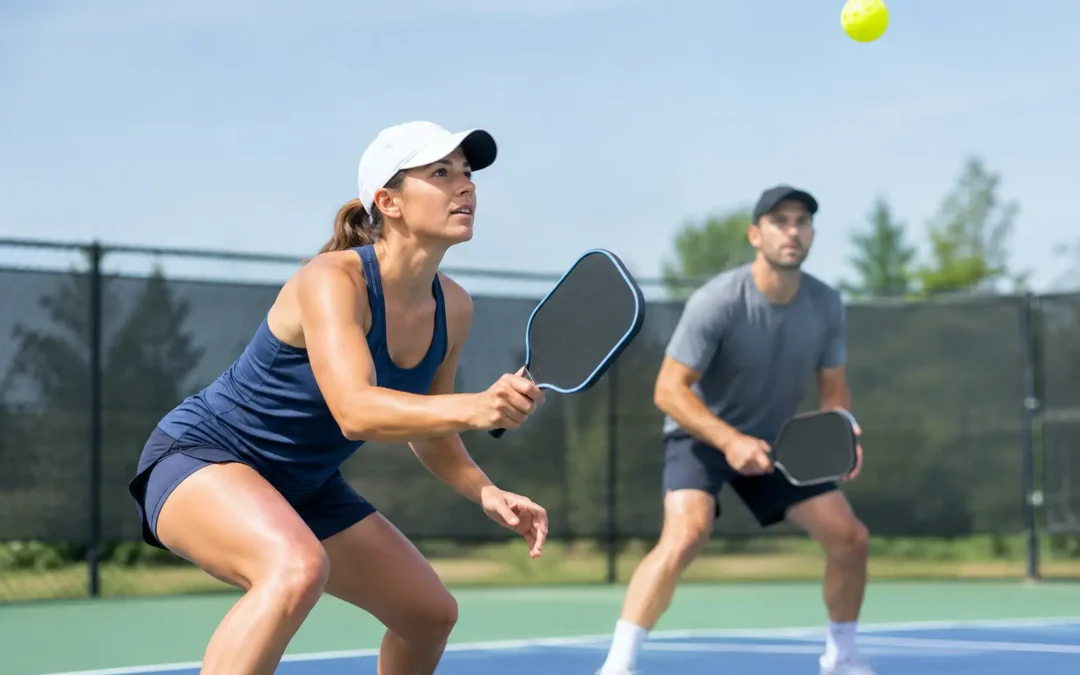
A well-placed lob can turn a comfortable kitchen-line exchange into a scramble in one second. That is why a smart pickleball lob defense guide starts before the ball goes overhead: with your ready position, paddle preparation, and ability to recognize when an opponent is trying to push you back.
At Around The Post Pickleball, our certified instructors see the same issue across clinics and competitive play in The Hamptons and Eastern Long Island. Players often react to the lob late, backpedal blindly, and give away the next shot. The goal is not simply to get the ball back. It is to recover safely, keep your team organized, and prevent one lob from turning into three defensive shots.
Pickleball Lob Defense Guide: Read It Before It Clears You
The best lob defense begins with anticipation. A quality lob usually comes from an opponent who has time, balance, and a paddle face that can lift the ball. If you are crowding the kitchen line with your paddle low, a lob can make you feel trapped. If you stay athletic and aware, you can turn earlier and move with purpose.
Watch the opponent’s contact point. A ball struck from below net height with an open paddle face may be a dink, but it may also be a disguised lob. Be especially alert when your opponent is under pressure but still has a comfortable, balanced stance. Many recreational players telegraph the shot by raising their paddle early or looking toward the back third of the court.
Your position matters, too. You do not need to stand several feet off the non-volley zone line in fear of the lob. That gives opponents easy space for soft dinks and drops. Instead, stay near the line with a slight athletic bend in your knees, your weight on the balls of your feet, and your paddle in front. This position lets you retreat quickly without sacrificing the kitchen-line advantage on every other ball.
The First Move: Turn, Run, Then Set Your Feet
The most common mistake against a lob is backpedaling while staring straight up. It feels natural, but it is unstable and makes an overhead or controlled return much harder. The better sequence is simple: identify the lob, turn your shoulders, move back quickly, then get your body under control before you hit.
If the lob travels over your outside shoulder, use a drop step. Turn toward the ball and run rather than shuffling backward. Keep your eyes on the ball, but do not let your head tilt so far back that you lose balance. As you approach the bounce or contact point, use small adjustment steps to create space.
Whether you hit an overhead depends on the depth of the lob and your own court position. A short lob that you can reach high and in front is an opportunity to hit an overhead with controlled placement. A deep lob that drives you near the baseline calls for a different decision. Let it bounce if needed, stay composed, and return a high-percentage shot rather than forcing a difficult winner.
The word that helps most players is “reset.” A lob does not require a highlight-reel response. It requires a response that puts the rally back on your terms.
When to Take the Ball in the Air
Take the ball out of the air when you can get behind it, contact it above shoulder height, and maintain balance. Aim your overhead into open space, toward the opponent’s weaker side, or safely down the middle. Avoid trying to paint the sideline while moving backward. The risk is high, and a miss gives away a point you could have stabilized.
If you are stretched, late, or drifting, choose control over power. A deep return that keeps opponents from closing the kitchen line is often the right shot. At intermediate and advanced levels, the strongest defensive overhead is frequently a firm, well-placed ball that buys time for you and your partner to move forward again.
Doubles Lob Defense Starts With Communication
In doubles, a lob is rarely a one-player problem. The player being lobbed must call the ball early, while the partner must recognize the change in court shape and help protect the next shot.
Useful calls are short and unmistakable: “Lob,” “mine,” “yours,” and “switch.” Do not wait until the ball is landing to communicate. The earlier the call, the better both players can move with confidence.
When one player retreats for a deep lob, the partner should not remain frozen at the kitchen line. That leaves a large gap between teammates and invites the opponents to hit down the middle or behind the advancing player. In most situations, the partner should retreat enough to stay connected and prepare for the next ball. You do not have to stand side by side at the baseline, but you do need to avoid becoming two isolated defenders.
A switch can make sense when the lob carries directly over one player’s head and the partner has a clearer route to the ball. It also helps when a stronger overhead player can take the shot without crossing into confusion. Still, switching is not automatic. If both partners call the same ball late, the result is usually a collision, a weak return, or no return at all. Agree on responsibilities before the match, especially when playing with a new partner.
Recover Forward Without Rushing the Kitchen
After returning a lob, many players sprint straight to the kitchen line. That is understandable, but it can be a costly habit. If your return is weak or sits up, charging forward exposes your feet and body to the next drive.
Read the quality of your own shot. If you hit a strong overhead or a deep, controlled groundstroke that pushes opponents back, move forward together and reclaim the non-volley zone line. If your ball is short, high, or easily attackable, pause around the transition zone. Split step as your opponents make contact and be ready to block or reset the next ball.
This is where patience separates steady teams from frantic ones. The kitchen line remains the best offensive position in pickleball, but arriving there at the wrong time is not an advantage. Earn your way forward with the quality of your return.
Four Lob Defense Errors That Cost Points
The same errors show up in open play, leagues, and tournament brackets. Correcting them does not require a new stroke. It requires better decisions under pressure.
- Backpedaling without turning. You lose balance, lose distance from the ball, and often contact it while falling away.
- Forcing an overhead from a bad position. A deep lob may call for a bounce and a controlled return, not a desperate swing.
- Leaving your partner at the kitchen line. One player retreats while the other stays forward, creating a gap opponents can exploit.
- Rushing forward after a weak reply. If your return is attackable, stop in the transition zone and prepare to defend one more ball.
The trade-off is straightforward: aggressive players may win a few points with spectacular overheads, but they will donate points if they attack every lob regardless of balance. Reliable players choose the ball they can execute, then recover as a team.
Drills That Make Lob Defense Automatic
Lob defense improves fastest when you practice the movement pattern, not just the overhead. Start with a partner at the kitchen line feeding alternating dinks and lobs. Your job is to identify the lob early, use a drop step, get under control, and return to a target. Begin at moderate pace so your footwork stays clean.
Next, add a recovery requirement. After your return, move forward only as far as the quality of the ball allows. Your partner should respond with either a drive or a soft drop, forcing you to decide whether to continue advancing or reset from the transition zone. This trains the part of lob defense that matters most in real games: the shot after the shot.
For doubles, run a communication drill with both defenders at the kitchen line. Feed lobs over either player and require an immediate verbal call. Include occasional middle lobs so partners can practice deciding whether to switch or let the original player handle the ball. Keep the focus on clear calls and connected movement rather than trying to hit every overhead hard.
Players preparing for leagues and tournaments should also practice lobs in wind. On outdoor courts across Eastern Long Island, a crosswind can turn a routine ball into a difficult read. Give yourself more room, track the ball longer, and accept that a safe bounce may be the best option when the wind is moving the ball late.
A lob only becomes a weapon when it creates panic. Stay balanced, communicate early, and make the next smart shot. With repetition, the ball over your head stops feeling like an emergency and becomes another chance to show calm, connected pickleball.