
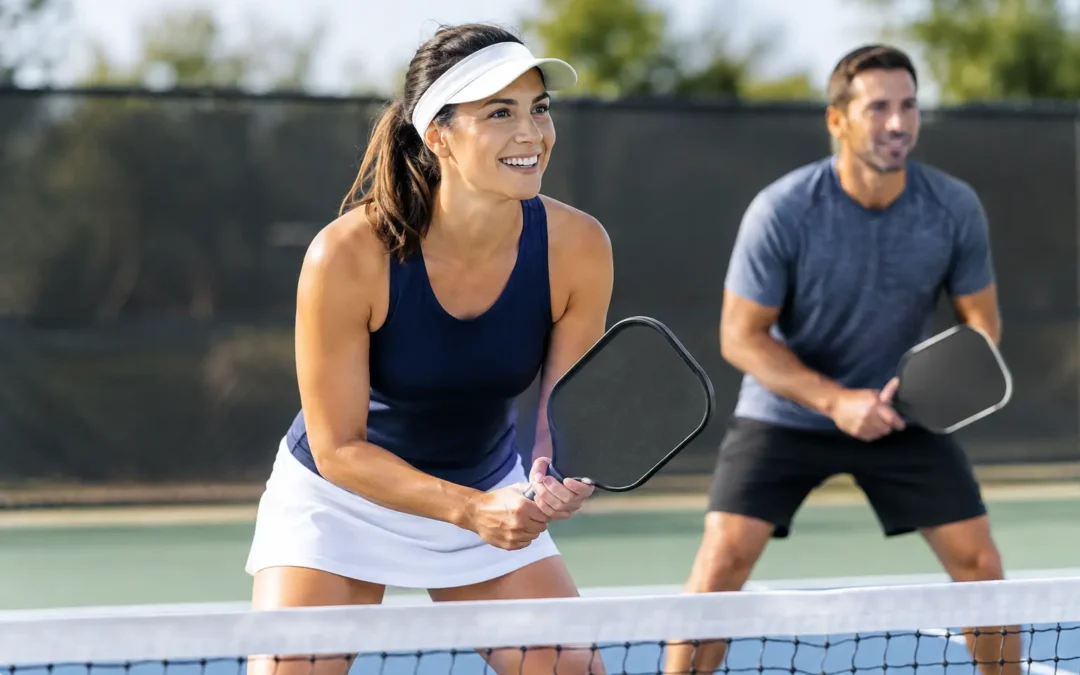
The ball is floating toward your side of the kitchen, and you have a choice: step in and make a controlled volley, or hesitate and let the point speed up around you. That split-second decision is where players either build confidence at the pickleball net or lose it. The good news is that net confidence is not reserved for naturally quick players. It is built through clear positioning, repeatable technique, and enough purposeful reps that your body knows what to do before doubt takes over.
For players across the Hamptons and Eastern Long Island, the net is often the difference between feeling like a participant in a game and feeling like you can shape the game. You do not need to hit harder. You need to arrive balanced, recognize the right ball, and trust a simple response.
Why the Net Feels Intimidating
The non-volley zone puts players close to the action. There is less time to react, more chance of getting tagged, and constant pressure to avoid popping the ball up. Many recreational players respond by standing too far back, dropping their paddle, or trying to swing their way out of trouble.
Those habits are understandable, but they make the game harder. A player standing several feet behind the kitchen line gives opponents more space to attack. A low paddle forces a late, upward motion. A large backswing turns a manageable volley into a rushed, inconsistent shot.
Confidence begins when you stop treating every fast ball as an emergency. At the net, your job is usually not to create a winner. Your job is to keep the ball low, neutralize pressure, and wait for a better opportunity. That mindset alone changes how the kitchen line feels.
Start With a Position You Can Trust
A confident net player is rarely frozen. They are in an athletic ready position: knees softly bent, weight toward the balls of the feet, chest up, and paddle held in front of the body. Keep the paddle head around chest height, with the tip slightly toward your backhand side. Because most fast exchanges arrive at the torso or backhand hip, this position reduces the distance your paddle needs to travel.
Stand close enough to the kitchen line that you can take a short step forward to volley, but do not crowd it so tightly that you lose balance. For most players, that means setting up just behind the line after reaching the non-volley zone. If a dink pulls you wide, recover toward the line and toward the center of your half of the court instead of admiring the shot.
Your feet matter as much as your hands. A small split step as your opponent strikes the ball keeps you active and ready to move. It may feel subtle at first, but it prevents the flat-footed reaction that causes so many late volleys. Think quiet feet, compact movement, and a stable base.
Give Yourself Permission to Use the Backhand
Many players try to run around backhand volleys because their forehand feels more familiar. At the kitchen, that decision often costs time. A compact backhand block is one of the most useful defensive tools in pickleball, especially against a fast ball at your body.
Instead of taking the paddle back, meet the ball out in front with a firm wrist and a short punch. The goal is not a dramatic swing. It is a controlled redirection that lands low in the kitchen or at an opponent’s feet. Once players trust this shot, the net immediately feels less crowded.
Build Confidence at the Pickleball Net With Better Decisions
Confidence is not reckless aggression. The strongest net players know which balls to attack and which ones to reset. Trying to speed up every dink may win an occasional point, but it also creates avoidable errors and gives opponents easy counters.
Attack when the ball is above net height, sits in front of you, and allows you to contact it without reaching. Aim at a player’s dominant hip, shoulder, or feet rather than trying to paint a sideline. A body shot limits their swing and often produces a weaker reply.
Reset when the ball is below net level, you are stretched wide, or an opponent has already put you under pressure. A reset is not surrender. It is a deliberate soft shot that returns the ball to the kitchen and gives your team time to recover. Advanced recreational players separate themselves by recognizing that patience is a skill.
There is also a practical trade-off with poaching. Moving across the middle to intercept a ball can energize your team and pressure opponents, but only when your partner understands the coverage behind you. If you poach without communicating, you can leave a wide lane open and create confusion. Call “mine,” move with purpose, and let your partner know whether they should slide or hold their side.
Train the Hands You Need in Real Games
Casual games offer useful repetition, but they do not always give you enough focused work on the shots that create net confidence. A better approach is to practice one skill at a time, then bring it into competitive play.
Start with cooperative dinking. Keep the ball crosscourt and give yourself a goal, such as 20 controlled dinks in a row without lifting the ball above net height. This teaches touch, patience, and visual tracking. As the rally becomes more stable, add movement by having each player take one ball slightly wider before recovering.
Then work on volley exchanges from the kitchen line. Begin at a manageable pace and prioritize compact contact over speed. Keep the paddle out front and practice redirecting balls to the opponent’s feet. If both players start hitting too hard, slow down. A drill only helps when it reinforces the mechanics you want under pressure.
Finally, practice the transition zone. One player begins near the baseline and advances after a third-shot drop, while the other player controls the point from the kitchen. The advancing player should focus on split stepping, blocking hard balls, and earning their way forward. This is where many players discover that their net issue is really a transition issue: they arrive at the line rushed and off balance.
At Around The Post Pickleball, certified instruction has helped more than 3,500 players turn these moments into repeatable habits. The fastest progress usually comes when players receive direct feedback on what is actually breaking down: paddle position, footwork, decision-making, or partner communication.
Make Pressure Part of Your Practice
A player can look composed in a cooperative drill and still tighten up at 9-9. That does not mean the drill failed. It means pressure needs its own practice.
Play short kitchen games where every rally starts with both teams at the non-volley line. Use a scoring format that rewards control, such as earning two points for winning a rally after five or more dinks. This encourages players to stay patient instead of forcing the first attack.
You can also give yourself a single performance goal for a rec game. Rather than judging the session by wins and losses, decide that you will hold your paddle up before every opponent contact, call every middle ball clearly, or reset one difficult ball instead of swinging at it. Small targets create measurable improvement and keep one missed volley from hijacking your confidence.
After a game, identify one pattern, not every error. Maybe opponents repeatedly attacked your right shoulder. Maybe you backed away from the line after dinking. Maybe your best volleys came when you stopped trying to do too much. A specific observation gives you something useful to carry into the next session.
Communicate So the Middle Stops Feeling Dangerous
Doubles confidence is shared. Even a technically sound player can hesitate when they are unsure who owns the middle ball. Establish the basics with every partner: forehands generally take middle balls when both players are equally positioned, the player facing the ball should call it, and any poach needs a loud, early signal.
The exact arrangement can change. Some teams prefer a stronger backhand in the middle, while others adjust based on mobility or a player’s favorite patterns. What matters is agreeing before the point, then communicating clearly during it. Silence creates hesitation, and hesitation creates pop-ups.
Encourage your partner after a missed attack or a difficult reset. The social side of pickleball is part of what makes local games and events so valuable, but supportive communication is also competitive. Teams that stay composed after an error make smarter decisions on the next ball.
Let Repetition Replace Hesitation
Net confidence does not appear after one great volley. It grows when you repeatedly get into the right position, choose the right response, and see the ball come back under control. Some days your hands will feel quick; other days, the best decision will be to reset and stay patient. Both are signs of a player learning to manage the point.
The next time you step to the kitchen line, give yourself one simple job: paddle up, feet active, ball out front. Play the next ball, not the last mistake, and let every controlled contact make the net feel a little more like home.