
The fastest way to feel at home on a pickleball court is not a perfect third-shot drop. It is knowing what to do when four people are waiting behind the fence, a ball rolls across your kitchen line, or a close call lands at your feet. This pickleball etiquette guide covers the habits that make open play smoother, matches more enjoyable, and local courts welcoming for players at every level.
Pickleball is social by design, but great court culture does not happen by accident. It comes from players who respect time, safety, partners, opponents, and the shared space. Whether you are joining your first game in the Hamptons or competing in a more serious Eastern Long Island session, these standards help you show up with confidence.
Pickleball Etiquette Guide: Start Before the Game
Good etiquette begins before the first serve. At a busy facility, do not assume an open court is yours just because you arrived early or recognize familiar faces. Learn the local system. Some venues use paddle racks, some use designated waiting areas, and others organize groups by level. Follow the format in place, even if it is different from the one you use at home.
If you are new to a group, introduce yourself and be honest about your experience. Saying, “I am newer and still learning the scoring,” is far better than pretending you know the routine and slowing down a game later. Most regular players are happy to help when they know what you need. The same is true for stronger players: be clear if you are looking for competitive games, but avoid treating recreational open play like a closed club.
Court selection matters, too. If a facility separates beginner, intermediate, and advanced sessions, choose the group that matches your current game, not the level you hope to reach next month. Playing up can be useful when everyone agrees to it. Consistently joining a level where you cannot sustain rallies, track scoring, or play safely can frustrate the group and limit your own development.
Arrive ready to play. Have your paddle, balls, water, and appropriate footwear sorted before it is your turn. When courts are full, a five-minute equipment search affects more than your game.
Respect the Rotation and Everyone’s Time
Open play works when players trust the rotation. If paddles are stacked in order, honor the order. Do not move yours forward, save a place for someone who has not arrived, or repeatedly pair only with your preferred partner when the system calls for mixing in.
There are exceptions. A parent may need to step out briefly, a player may be managing an injury, or a host may be organizing a structured session. Those situations call for common sense and a quick conversation, not rigid policing. Still, the baseline is simple: no one should have to argue for a fair turn.
When there is a line, finish your match with purpose. That does not mean rushing through points or skipping proper sportsmanship. It means avoiding long coaching sessions between rallies, extended debates over a call, or a second game with the same four players while others wait. If your group plays win-by-two, follow the venue norm. If time is limited, many open-play groups use one game to 11, then rotate.
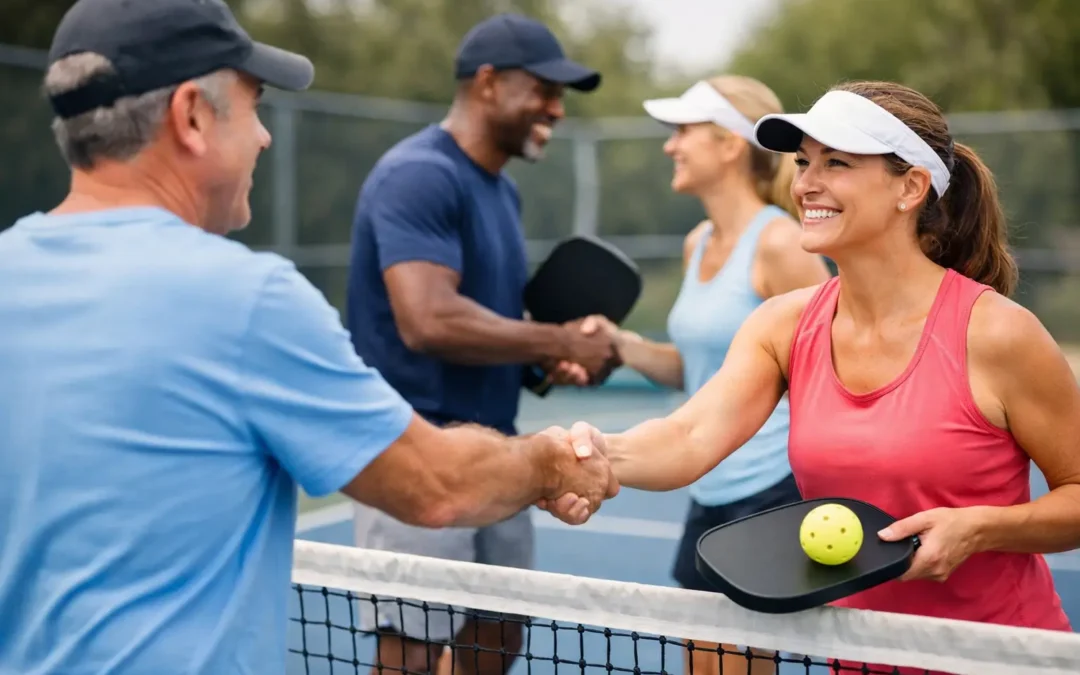
After a game, acknowledge your opponents, collect your belongings, and clear the court promptly. A genuine “good game” goes a long way. So does making space for the next four players without being asked.
Make Fair Calls Without Making a Scene
Line calls are one of the clearest tests of pickleball etiquette. The rule of thumb is straightforward: call the ball on your side of the net. If you see it clearly out, call it out immediately. If you are not sure, give your opponent the benefit of the doubt and call it in.
Close calls happen quickly, especially on a deep return or a fast drive near the baseline. Avoid guessing from where you hoped the ball landed. Your partner may have had a better view, so communicate quickly and calmly. If either partner is uncertain, the ball is in.
Call “out” loudly enough for all four players to hear, ideally before an opponent hits the next shot. A raised hand can help signal the call, but do not rely on a silent gesture during a noisy match. If you call a ball out and then realize it was in, correct it right away. Owning an error earns more respect than defending a bad call.
Do not challenge every close call by your opponents. You can ask, respectfully, “Did you see that clearly?” if a ball was particularly close or the call seemed delayed. But unless you are playing with an official, their side of the court is their call. Replaying points should be rare and only happen when everyone agrees there was a genuine interruption or uncertainty.
A little generosity protects the quality of the game. Winning a recreational point because of a disputed millimeter is never worth making the court uncomfortable.
Safety Comes Before the Point
The most important rule on a busy court is to stop play when a loose ball enters your court. Call “ball” loudly and clearly. Do not try to finish the rally while someone is stepping around an obstacle, and do not assume the other team saw it. Restart the point once the court is safe and everyone is ready.
The same standard applies when your ball rolls onto another court. Wait until the point ends, retrieve it without crossing behind active players whenever possible, and offer a quick apology if you caused the interruption. Never run across a live court to chase a ball.
At the non-volley zone line, give other players space. Avoid crowding an adjacent court, swinging your paddle carelessly near people, or backing into another group during a lob chase. If you are pursuing a ball near a fence or neighboring court, use your voice. A quick “mine” or “coming through” can prevent a collision.
Play under control. Competitive energy is part of pickleball, but reckless body shots, uncontrolled paddles, and aggressive celebration have no place in a shared recreational environment. A well-placed drive is legal. Repeatedly targeting a less experienced player at close range may be tactically available, but it is not always the right choice for a social game. Read the setting.
Be the Partner People Want to Play With
Your partner deserves your attention, especially when the score tightens. Call the score clearly before every serve, confirm it if there is confusion, and communicate on balls down the middle. A simple “yours,” “mine,” or “switch” is more useful than a lecture after the point.
Avoid correcting your partner during a game unless they ask for help. Even well-meant advice can feel like blame when it arrives after every missed return. If you are playing with someone newer, keep your encouragement specific: “Great reset” or “Nice job getting to the kitchen” is more helpful than empty praise. If they ask a question, answer briefly and get back to playing.
Strong players set the tone. You do not have to avoid competitive shots, but you can choose to create rallies, involve all four players, and model good communication. Newer players will remember who helped them feel included. That is how a local pickleball community grows.
At Around The Post Pickleball, certified instructors have taught more than 3,500 players across the region, and one lesson comes up again and again: confidence grows fastest in an environment where people can make mistakes without being embarrassed.
Keep Competitive Play Competitive and Social Play Social
Not every game has the same purpose. A drill-heavy advanced session, a tournament bracket, a beginner clinic, and a Saturday open-play game each carry different expectations. The best players adjust their approach instead of forcing one style everywhere.
In a competitive game, direct strategy is fair. You may target the weaker wing, speed up at the right moment, and use every legal tactical advantage. In a casual mixed-level game, the better question is whether your choices are helping all four players enjoy the rally. It depends on the group, the stated format, and the reason everyone came out to play.
If you want a more serious match, ask. “Would you like to play a competitive game?” is clear, respectful, and far better than surprising a recreational group with tournament-level intensity. Likewise, if you are looking for a relaxed game, say so. Clear expectations prevent most court tension before it starts.
Bring the Right Energy After Every Point
Celebrate your own good play without celebrating someone else’s error. A quick paddle tap, a smile, or a “nice shot” is plenty. Loud reactions after an opponent misses an easy ball can make a friendly game feel personal fast.
Apologize briefly for net cords, body shots, or shots that create an awkward moment, then move on. You do not need to apologize for playing a legitimate, well-executed point. The goal is awareness, not hesitation.
Pickleball etiquette is not about being overly formal. It is about making the court a place where people want to return. Make the fair call, take your turn, protect the players around you, and leave every game with the same respect you hoped to receive when you walked on court.