A new court can become the center of a property, a club, or a summer calendar. But pickleball court construction is not simply a matter of pouring pavement, adding a net, and picking colors. The details beneath and around the playing surface determine whether the court feels crisp underfoot, drains after a coastal storm, stays comfortable for neighbors, and holds up through Northeast winters.
For homeowners, clubs, resorts, and event hosts across The Hamptons and Eastern Long Island, the best courts are built for the way people actually play. That means welcoming first-timers, giving experienced players enough room to chase a lob, and creating a setting people want to return to for clinics, round robins, private parties, and competitive matches.
Start Pickleball Court Construction With the Site
The regulation playing area is 20 feet by 44 feet, the same footprint as a doubles badminton court. That is only the beginning of the space conversation. A court needs safe run-off room beyond every line. For recreational use, a total area of roughly 30 by 60 feet is a practical starting point. For a premium experience, particularly where stronger players will compete or instruction will take place, 34 by 64 feet or more gives players the freedom to move naturally.
Before choosing a location, consider sun, wind, access, drainage, and nearby homes. An east-west court orientation is usually preferred because it reduces direct sun in players’ eyes during morning and late-afternoon play. On a property where orientation options are limited, thoughtful lighting, landscaping, and scheduling can help, but the sun angle should be assessed before the base work begins.
Eastern Long Island also brings site-specific realities. Sandy soils, high water tables in some areas, salt air, mature landscaping, and strict local zoning can all affect the plan. A beautiful corner of a property may look ideal until drainage, setbacks, tree roots, or equipment access are considered. Site preparation is where a project becomes either predictable or expensive.
Permits and neighbor considerations matter early
Do not treat permitting as a last-step administrative task. Municipal requirements can affect fencing height, lighting placement, setbacks, stormwater management, and hours of use. If the court is part of a commercial property, private club, or hospitality venue, accessibility and occupancy considerations may also come into play.
Sound is another practical issue. Pickleball has a distinctive, sharp ball-on-paddle sound, especially during active group play. Distance, fencing systems, landscape buffers, court hours, and the selection of quieter equipment can all be part of a good neighbor plan. The goal is not to eliminate the energy of the game. It is to make sure the court fits its surroundings as well as it fits the players.
Build the Base for Northeast Weather
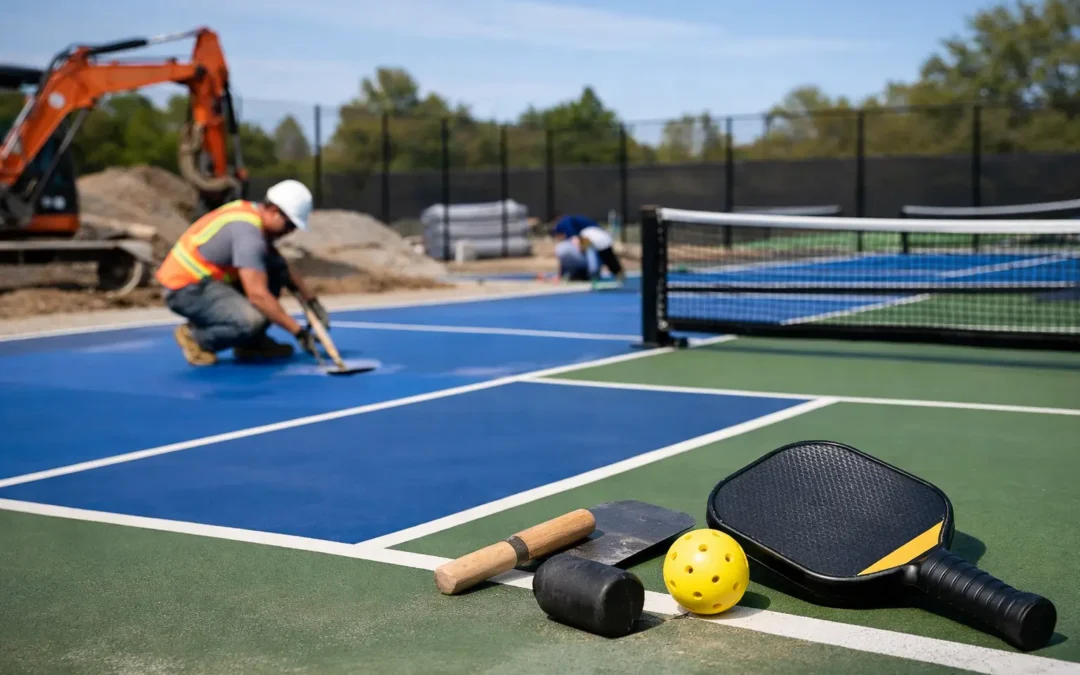
The surface color gets attention, but the base does the hard work. A pickleball court needs a stable, properly graded foundation that resists movement and moves water away from the playing area. Poor drainage can lead to puddling, premature cracking, surface wear, and frustrating downtime after rain.
Asphalt and concrete are the most common hard-court foundations. Each can perform well when installed correctly, and the right choice depends on the site, budget, climate, and intended use. Asphalt is often selected for its flexibility and initial cost advantages. Concrete can provide a highly stable, long-lasting slab, but it requires careful joint planning and can carry a higher upfront investment.
Neither option is automatically better in every setting. What matters is the excavation, compacted stone base, grading, drainage strategy, and quality of installation. On Long Island, where freeze-thaw cycles and seasonal moisture can expose weak construction quickly, shortcuts below the surface tend to show up above it.
A court should be graded to shed water without creating a noticeable slope during play. Even a subtle low spot can change how the surface dries and create a safety concern. Drainage swales, perimeter systems, and proper runoff management should be designed with the site rather than added as an afterthought.
Choose a Surface for How You Will Use the Court
Acrylic sports coatings are a popular finish for dedicated pickleball courts because they provide color, traction, and clear striping. They also allow owners to create a polished visual identity, whether that means traditional blue and green, a private-club palette, or a color scheme that fits a home or hospitality setting.
Surface texture is a balance. Players need enough traction to change direction confidently, especially during quick kitchen-line exchanges. Too much texture can feel abrasive, wear out balls faster, and become harder on the body over long sessions. Too little can feel slick, particularly when humidity or light moisture is present.
Cushioned systems are worth considering for facilities that expect frequent play, older adult players, clinics, or long tournament days. They can improve underfoot comfort and reduce impact, though they add cost and should be evaluated as part of the full system, not as a quick top-layer upgrade. A serious player may prioritize consistent ball response; a host focused on social play may value comfort and appearance more. The best answer depends on the audience.
If tennis lines already exist, temporary pickleball striping can work for casual use. For a court intended to be a centerpiece, permanent dedicated lines are cleaner, easier for beginners to understand, and better for organized programming. A dedicated court also avoids the compromises that come with adapting a larger surface to a faster, more compact game.
Fencing, Nets, and Lighting Shape the Experience
The perimeter affects both play and atmosphere. Chain-link fencing is durable and familiar, while darker vinyl-coated fencing can visually recede and create a more polished look. A typical fence height is four feet, with higher sections behind baselines when the location, budget, or neighboring conditions call for more ball containment.
Gate placement deserves real thought. Players should be able to enter without crossing an active court or interrupting a point. For multi-court layouts, circulation paths, spectator areas, shade, and seating should be planned before fencing is installed. This is especially important for clinics and events, where players rotate frequently and instructors need room to communicate.
A permanent net system delivers a more professional result than a portable net, particularly for regular play. The net should be 36 inches high at the sidelines and 34 inches at the center. Durable posts, correct tension, and a reliable center strap help the court play consistently from day one.
Lighting turns a good court into a flexible amenity. For evening play, fixtures should provide even coverage without glare spilling into neighboring properties. Poorly positioned lights can make a high lob disappear at the exact wrong moment. Quality LED systems offer efficiency and strong visibility, but layout, mounting height, controls, and local regulations matter as much as the fixture itself.
Design for Community, Not Just Matches
The strongest court projects recognize that pickleball is both athletic and social. A single court may be perfect for family play and private lessons. Two or more courts create far more opportunity for round robins, corporate experiences, team-building programs, tournaments, and clinics that keep players engaged while they wait to rotate in.
For venues planning organized play, build in a little more than the minimum. Benches, shade, water access, a visible check-in area, and room for players to gather can transform operations. So can thoughtful spacing between courts, which helps reduce distractions and gives instructors space to coach safely.
Around The Post Pickleball has taught more than 3,500 players across the region, and that experience reinforces a simple point: a court is only as valuable as the experience it supports. Beginners need clear lines, approachable programming, and room to learn. Competitive players need dependable footing, true dimensions, and a surface they can trust during fast exchanges. Hosts need a facility that looks as good at a private event as it performs during a serious clinic.
Plan the Budget Around Long-Term Value
Court costs vary widely because every site is different. Excavation, drainage, access constraints, base material, fencing, lighting, landscaping, electrical work, permits, and surface systems can all change the final number. A straightforward backyard project on a level, accessible site will not carry the same budget as a multi-court installation with lighting, extensive drainage, and event-ready amenities.
The right question is not simply, “What is the least expensive way to build a court?” It is, “What will this court need to deliver over the next decade?” Spending appropriately on base preparation and drainage often protects the investment more effectively than spending heavily on cosmetic upgrades. Plan for maintenance as well. Courts need cleaning, occasional crack repair, line touch-ups, and resurfacing over time.
A well-planned court creates more than a place to hit a ball. It gives friends a reason to gather, gives players a place to improve, and gives a property a feature that stays active long after the first match is over.