
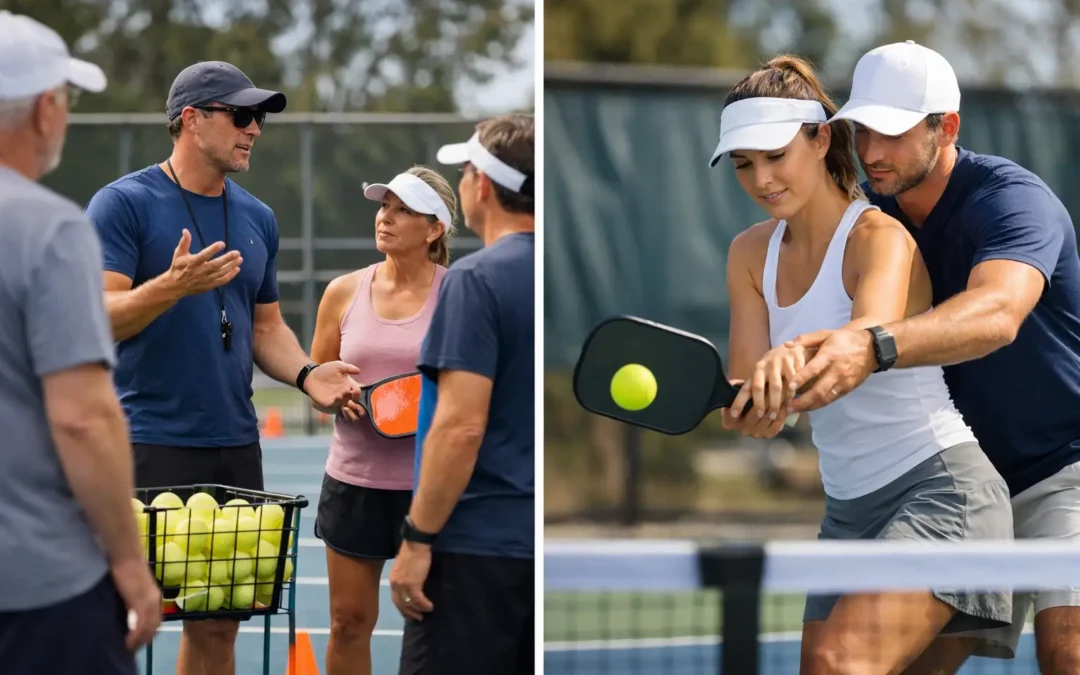
A two-hour session can change the way you see the game. But when choosing pickleball bootcamp versus lessons, the better option is not always the one with the most court time. It is the one that matches where you are now, how you learn, and what you want to accomplish the next time the ball comes to your paddle.
For players across the Hamptons and Eastern Long Island, that distinction matters. Some players need a concentrated reset before a season of league play. Others need patient, personalized coaching to stop popping up their third-shot drops or getting caught out of position at the kitchen. Both formats can produce real progress when they are led well. They simply create progress in different ways.
Pickleball Bootcamp Versus Lessons: The Core Difference
A pickleball bootcamp is a focused, high-energy training experience built around repetition, movement, and game situations. It usually runs longer than a standard lesson and brings players together around a shared objective: improve faster, train with purpose, and leave with more confidence in live points.
Private or small-group lessons are more personalized. The instructor can study your grip, footwork, contact point, shot selection, and decision-making, then adjust the session around the specific issue holding your game back. Instead of fitting your needs into a group curriculum, the curriculum fits you.
Neither format is automatically better. A bootcamp delivers volume and momentum. Lessons provide precision and individualized feedback. The right choice depends on whether you need more reps, clearer correction, or a combination of both.
When a Pickleball Bootcamp Makes Sense
Bootcamps are ideal for players who already understand the basic rules and want to become more capable in a short, concentrated window. You may have played casually for months, know how to serve and keep score, and still feel like faster players expose the same weaknesses. A well-run bootcamp gives those weaknesses nowhere to hide.
Expect purposeful drills rather than random hitting. Players may work on dinking under pressure, resetting hard drives, serving with intention, returning deep, moving as a doubles team, and recognizing when to speed up versus when to stay patient. The best bootcamps connect every drill to match play, so the work does not disappear once points begin.
The group environment is part of the value. Training alongside other motivated players raises the pace and adds variety to the ball patterns you see. You learn not only from direct coaching, but also by watching how other players solve the same tactical problems. For social players, it is also an excellent way to meet partners who want structured play rather than another unorganized open-play session.
A bootcamp is particularly useful before a tournament, league season, vacation weekend, or a stretch when you know you will be playing often. It can sharpen your reactions and give you a clear plan for the next stage of your game. At Around The Post Pickleball, that kind of high-touch, drill-driven environment reflects the same standard that has helped more than 3,500 players train with greater confidence across Eastern Long Island.
What bootcamps do especially well
A strong bootcamp can create meaningful improvement in a few areas at once: consistency, court awareness, competitive comfort, and conditioning. The extended format allows players to repeat a skill enough times to feel the difference between a lucky shot and a reliable one.
It also helps players who tend to practice only what they already do well. In a structured session, you will spend time on the uncomfortable shots: backhand dinks, transition-zone resets, overheads, and defending speed-ups at your feet. That is often where game-changing improvement begins.
The trade-off is individual attention. Even with excellent certified coaching, an instructor is managing a group. You will receive feedback, but it will not be as constant or as customized as a private lesson. If you have a very specific technical problem, bootcamp may expose it without fully resolving it in a single session.
When Pickleball Lessons Are the Better Investment
Lessons are the strongest choice when you want an instructor to diagnose your game closely. This is especially valuable for beginners, players returning after time away, and intermediates who have hit a plateau despite playing regularly.
A beginner may need help with the fundamentals before jumping into a faster group setting: how to hold the paddle, where to stand for a return, why the non-volley zone matters, and how to move with a partner. A private lesson creates a welcoming, lower-pressure place to ask questions and build those habits correctly from the start.
For an experienced player, the issue may be more subtle. Perhaps your third-shot drop is too high because your contact point is late. Maybe you are losing crosscourt dink exchanges because you lean instead of moving your feet. Or perhaps your drives are effective, but you rush forward behind them and leave your partner exposed. Those are individual patterns. They respond best to individualized observation, correction, and repetition.
Lessons also make sense when time is limited. A focused hour with a certified instructor can be more productive than several casual games because every drill has a reason. You are not waiting for a court, adapting to uneven competition, or reinforcing the same mistake through another afternoon of open play.
The value of a lesson is in the feedback loop
The most important advantage of a lesson is immediate adjustment. You try a shot, receive clear feedback, make a change, and test it again. That loop helps a player understand not just what to do, but why it works.
Private lessons are also adaptable. If you arrive wanting to work on serves but your instructor sees a bigger issue with your ready position, the session can shift. If you are preparing for a particular tournament partner, a small-group lesson can focus on communication, stacking, court coverage, and the patterns you plan to use together.
The trade-off is that lessons can feel less like a full competitive workout. You may get fewer live-game reps and less exposure to different styles of opponents than you would in a bootcamp. Players who only take lessons can understand the right decision without yet feeling comfortable making it at speed.
Consider Your Goal, Not Just Your Level
Skill level matters, but your immediate goal matters more. A 3.0 player who wants to clean up a recurring backhand error may benefit most from a lesson. A 3.0 player preparing for a social tournament in two weeks may benefit more from a bootcamp that includes transition drills and competitive scenarios.
Similarly, a 4.0-level competitor does not always need advanced instruction in every area. That player may choose a private session to refine a single tactical weakness, then use a bootcamp for pressure reps and high-level point construction. Strong players often improve fastest by moving between the two formats rather than treating them as competing choices.
Be honest about how you respond to coaching. If you thrive on energy, friendly competition, and extended court time, bootcamp may bring out your best. If you prefer detailed feedback, a slower build, and a plan tailored to your mechanics, lessons may be the smarter first move.
A Smart Way to Combine Both
For many players, the best answer to pickleball bootcamp versus lessons is not either-or. Start with a lesson if you need a foundation or have a clear technical issue. Then use a bootcamp to pressure-test the improvement against live balls, movement, fatigue, and different opponents.
That sequence works because lessons establish the correction, while bootcamps help make it automatic. For example, you might learn how to soften your hands on resets in a lesson, then spend a bootcamp defending drives and practicing those resets when the pace increases. The skill becomes more dependable because you have practiced it in context.
You can reverse the order, too. A bootcamp may reveal that you repeatedly struggle with one situation, such as moving through the transition zone or defending the middle. A follow-up lesson gives you the targeted coaching needed to turn that discovery into a solution.
Choose Coaching That Gives You a Clear Next Step
Whatever format you choose, look for structured instruction led by coaches who can explain the purpose behind the drill. Credentials matter, particularly when coaches hold formal IPTPA and PPR training, but the real test is whether you leave knowing what to practice next and how it will improve your match play.
The best session should not leave you with a vague feeling that you hit a lot of balls. It should leave you with one or two changes you can recognize on court: a deeper return, a calmer reset, better spacing with your partner, or a more patient decision at the kitchen line.
Pick the experience that meets your game where it is today. Then bring that new skill to your next game, ask for the ball, and give yourself enough purposeful repetitions to make the improvement stick.