
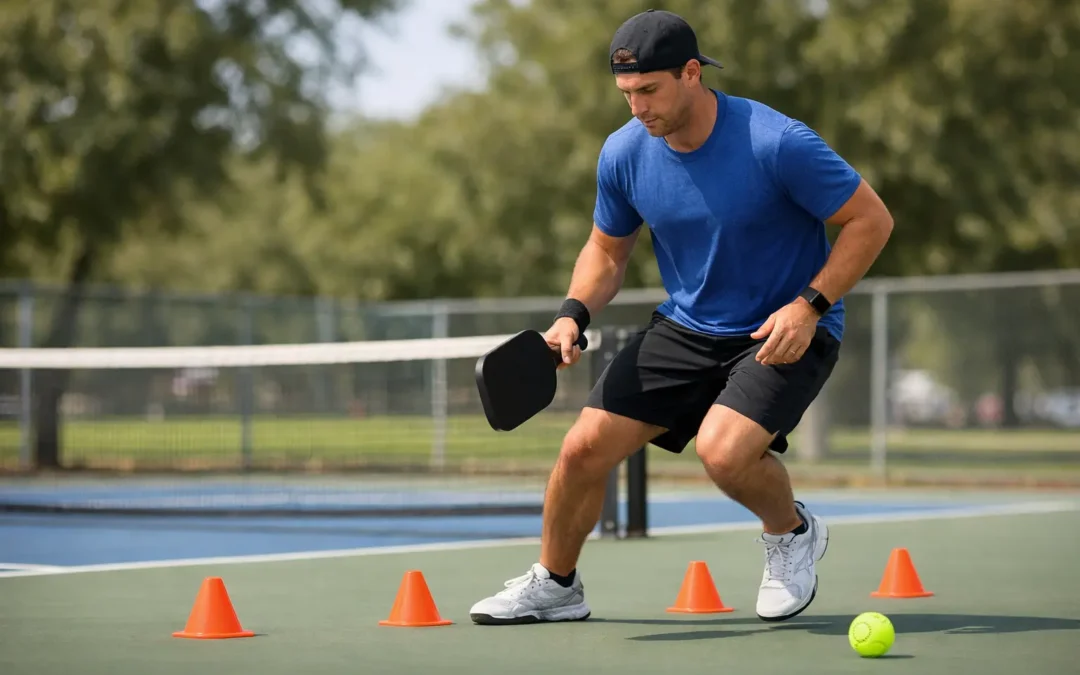
You feel it most on the balls you almost reach. The dink you read correctly but arrive late to. The return you hit well, then recover a step too slowly. If you want to know how to practice pickleball footwork solo, start there – not with fancy drills, but with the reality that better movement is often the fastest way to play better.
At every level, footwork is the difference between being rushed and being in control. Beginners need it to build balance and confidence. Intermediate players need it to stop drifting, crossing their feet, or getting caught flat-footed in transition. More advanced recreational players need it to clean up efficiency so they can recover faster, stay low through contact, and handle speed without looking frantic. The good news is that footwork is one of the easiest parts of pickleball to train on your own.
Why solo footwork work pays off fast
When players think about solo practice, they usually picture serves or wall drills. Those matter, but footwork has a bigger carryover than most people expect because it shows up on every point. Good movement helps you arrive balanced, and balance gives you cleaner contact. Cleaner contact gives you more control. That chain matters whether you’re defending at the kitchen, moving through the transition zone, or recovering after a wide forehand.
Solo footwork training also gives you something live play does not – repetition without interruption. In a game, you might only get a handful of chances to rehearse a specific movement pattern. On your own, you can repeat the same split step, lateral shuffle, drop step, and recovery dozens of times until it feels automatic.
There is a trade-off, though. Solo work can sharpen movement patterns, but it cannot fully replace reading a live ball. That means your goal is not to mimic match play perfectly. Your goal is to build habits that hold up once the ball is added back in.
How to practice pickleball footwork solo the right way
The biggest mistake players make is moving fast before they move well. Speed looks athletic, but bad patterns repeated quickly just become harder to fix later. Start with positions and timing. Then add pace.
Your base athletic position should feel simple and repeatable – feet a little wider than hips, knees bent, chest up, weight slightly forward, and heels light. From there, most pickleball movement comes down to a few essentials: the split step, the lateral shuffle, the crossover run for bigger distances, the drop step when you need to open and chase, and the recovery step back to a strong ready position.
If you have access to a court, use the actual lines. If not, a driveway, patio, garage, or flat stretch of grass can work. You only need enough space to move side to side, forward, and back without slipping.
Start with the split step
If your feet are dead when your opponent makes contact, everything after that gets harder. The split step is the small hop or load that gets you ready to react. It is not dramatic. It is quick, quiet, and balanced.
Practice by standing in ready position and doing a light split every few seconds, landing on the balls of your feet with knees bent. The key is timing your landing as if the opponent is striking the ball. Then move one or two steps in a chosen direction and recover to center. Do this slowly at first. You are training readiness, not just motion.
Build your lateral game
Most pickleball points are won and lost in short side-to-side adjustments. That is why the shuffle matters so much. Mark a small lane with cones, shoes, or even towels. Start in the middle, shuffle two or three steps right, touch your outside line, then recover. Repeat left.
Stay low and resist the urge to click your feet together. Your stance should stay active, not tall. If you feel your shoulders bouncing up and down, you are probably rising too much between steps.
Train the transition zone
A lot of recreational players move well at the baseline and feel fine once established at the kitchen, but the space in between exposes them. Practicing forward movement with control helps a lot here.
Start at the baseline. Split step, move forward three controlled steps, stop in balance, reset your feet, then continue forward. Think about staying compact rather than charging. On the way back, do not backpedal if you can avoid it. Practice opening your hips, turning slightly, and using controlled recovery steps. That movement is safer and more game realistic.
The solo drills that actually transfer to matches
You do not need twenty drills. You need a few patterns done consistently and correctly.
Shadow kitchen movement
Stand at the non-volley zone line and imagine a dink exchange. Shuffle one or two steps right, plant, simulate contact, recover. Then go left. Add a ball pickup if you want a visual cue, but the real focus is staying low and recovering under control.
This drill teaches two things many players miss: how small the adjustment steps usually are at the kitchen, and how important it is to recover without popping upright.
Baseline to kitchen advance
Start at the baseline and simulate a return. Then move forward under control in stages, split stepping as if your opponent is about to hit. This is a great way to practice closing space without overrunning the next ball.
If you tend to sprint straight through the transition zone in games and get caught off balance, this drill helps you feel the rhythm of move, settle, react.
Wide ball recovery drill
Start in the middle. Push out wide to your forehand side, set your base, then recover. Repeat on the backhand side. For shorter distances, shuffle. For bigger distances, use a crossover or drop step to cover ground faster.
This is where it depends on the scenario. If the ball pulls you just a little off center, the shuffle is cleaner. If you are chasing a much wider ball, forcing a shuffle usually makes you late. Good footwork is not one movement pattern every time. It is choosing the right one.
Cone box drill
Set four markers in a small box. Move around them while maintaining athletic posture – forward, right, back, left, then reverse. This helps with directional changes and teaches your feet to stay organized when movement gets less linear.
Keep it crisp. If the drill turns into random running, it loses value.
Common solo footwork mistakes
The most common issue is training too upright. Pickleball rewards players who can stay loaded through the shot, especially at the kitchen. If you rise up every time you move, you lose time on the next ball.
The next problem is overstriding. Big steps feel powerful, but they often make players late to reset. In pickleball, small adjustment steps are often more valuable than one dramatic lunge.
Another mistake is ignoring recovery. Reaching a spot is only half the job. You also need to get back into a position that lets you handle the next shot. A good solo session should make recovery feel just as important as the first move.
Finally, avoid marathon sessions. Footwork quality drops when fatigue takes over, and then the pattern work gets sloppy. Ten to fifteen focused minutes can do more than forty unfocused ones.
How often should you practice pickleball footwork solo?
For most adult players, two to four short sessions per week is enough to see real improvement. Consistency matters more than volume. If you already play several times a week, add ten minutes before or after a session. If you are working around a busy schedule, even three focused home sessions can sharpen your movement.
A simple structure works well: one day focused on kitchen movement, one on transition movement, and one on wider recovery patterns. If you are newer to the sport, keep the intensity moderate and prioritize clean repetitions. If you are more experienced and already move well, increase pace and reaction demands.
Make it more realistic without a partner
The challenge with solo work is decision-making. You know where you are going before you move. To fix that, add unpredictability. Call out directions to yourself at random. Use colored markers and decide movement based on color. Set a timer with random beeps and react on the sound.
You can also pair shadow swings with the movement so your body learns the full sequence: recognize, move, set, swing, recover. That is where solo footwork starts feeling more like pickleball and less like generic conditioning.
Players who want measurable improvement usually do best when solo work is paired with coached feedback. That is especially true if you have recurring habits like crossing your feet in small spaces, retreating straight backward, or recovering too slowly after wide balls. Strong movement is teachable, but details matter.
At Around The Post Pickleball, we see this all the time with players across the Hamptons and Eastern Long Island. The players who improve fastest are not always the youngest or quickest. They are usually the ones who practice movement with intention.
Better footwork does not need to look flashy. It should look quiet, balanced, and repeatable. If your next solo session helps you get to the ball a little sooner and arrive a lot more under control, you are training the part of pickleball that makes everything else easier.