
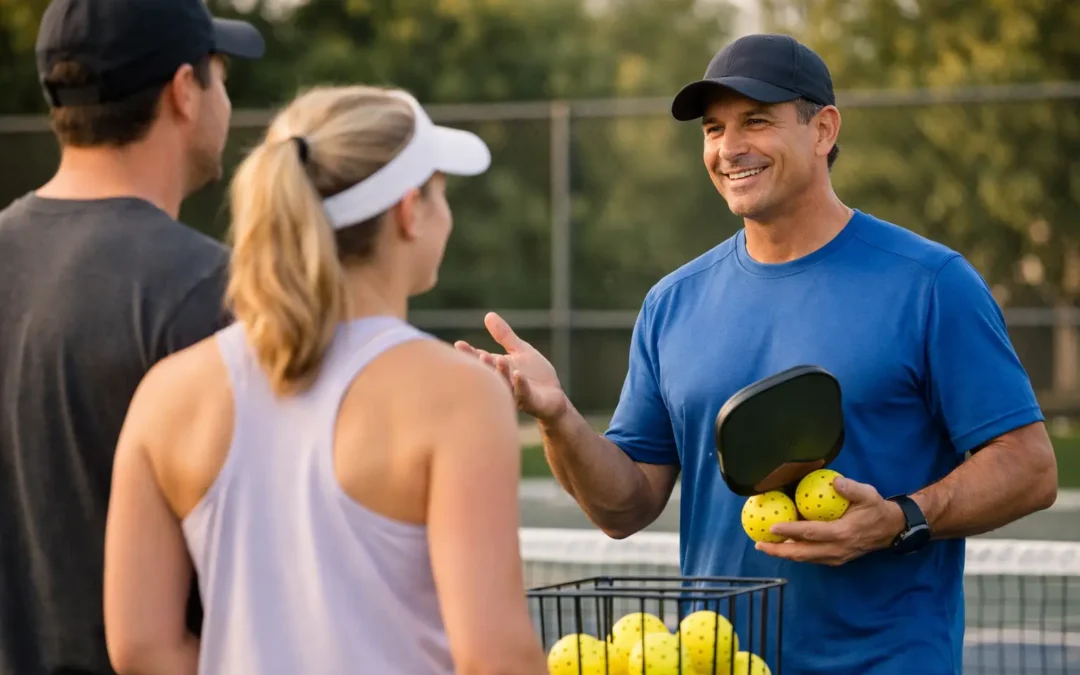
A great pickleball coach does more than feed balls and call out tips between points. The right coach helps you understand why a shot breaks down, gives you a clear way to fix it, and makes you want to come back and work. If you are wondering how to choose a pickleball coach, start by looking beyond a strong playing record. Your best fit is someone who can teach your current game, your goals, and the way you learn.
For players across The Hamptons and Eastern Long Island, that choice can shape how quickly pickleball becomes part of your week. The right instruction builds confidence for a first open-play session, gives intermediate players better decisions at the non-volley zone, and helps competitive players train with purpose.
Start With Your Actual Goal
Before comparing coaches, get specific about what you want from lessons. “Get better” is a fair starting point, but it is not enough to identify the right program. A new player may need help with scoring, court positioning, serve returns, and the basic rhythm of doubles. A 3.0 player may be tired of pop-ups and rushed resets. A 4.0-level competitor may want drill-heavy work on transition-zone defense, third-shot choices, speed-ups, and partner communication.
Your goal affects the format as much as the coach. Private lessons offer focused feedback and can be the fastest route to correcting a technical issue. Small-group clinics create repetition, live-ball problem solving, and the social energy that makes pickleball stick. Boot camps and advanced sessions can be a better match when you want concentrated training rather than an occasional tune-up.
Ask a prospective coach what a first session looks like for someone at your level. A useful answer should include observation, clear priorities, and a plan for progress – not a one-size-fits-all promise.
Look for Coaching Credentials, Not Just Playing Credentials
A coach who plays well is not automatically a coach who teaches well. High-level players may have excellent instincts, but instruction requires the ability to break movement, strategy, and decision-making into steps that another person can use under pressure.
Formal certification is one meaningful signal. Organizations such as IPTPA and PPR train instructors in teaching methodology, player development, safety, and effective lesson structure. Credentials are not the only measure of quality, but they show that a coach has invested in becoming an educator, not simply a skilled player offering advice.
Experience matters alongside certification. Ask how many players the coach has taught and whether they regularly work with your type of player. Teaching beginners requires patience, clarity, and an ability to make the game feel approachable. Teaching stronger recreational and competitive players requires sharper technical observation, purposeful drills, and a real understanding of doubles patterns.
At Around The Post Pickleball, certified instructors have taught more than 3,500 players, from first-timers to 4.0-level competitors. That volume matters because experienced coaches have seen the common issues repeatedly: the grip that limits a backhand, the footwork that causes a late contact point, the decision that turns a neutral ball into an opponent’s attack.
Watch How the Coach Communicates
The fastest way to understand a coach’s style is to observe a clinic or take one lesson. Pay attention to whether the instruction is clear, encouraging, and specific. “Keep your paddle up” is a useful reminder. “Bring your paddle to a ready position after every shot so you can defend the next ball without a big swing” gives the player an action and a reason.
Good coaches avoid overwhelming students with ten corrections at once. They identify the most important adjustment, give the player repetitions, then revisit the result. They also adapt their language. One player may respond to a technical cue about shoulder position, while another needs a simple image or a tactical target.
Look for a coach who creates an environment where questions are welcome. Pickleball can feel intimidating when everyone else seems to know the score, the etiquette, and the unwritten rules of the kitchen line. The right coach makes room for those questions without making anyone feel behind.
Make Sure the Lesson Includes More Than Drilling
Drills are essential, especially when you are building a new skill. You need repetitions to develop a dependable dink, return, drop, reset, or volley. But pickleball is a decision-making sport. A coach should eventually connect technique to the situations you face in real games.
That means explaining when to drive rather than drop, why a ball should be reset instead of attacked, how to move with a partner, and where to place a return to create time. It also means allowing players to apply a skill in live-ball play, where the pace and pressure are different from a controlled drill.
For beginners, the balance may lean toward fundamentals and basic game flow. For experienced players, it should increasingly include patterns, transitions, shot selection, and point construction. There is no single correct lesson formula, but a session that never moves beyond feeding balls may not prepare you for open play, league matches, or tournament competition.
Ask About Progression and Practice Between Sessions
The best coaches give you a path forward. You should leave a lesson knowing what improved, what still needs attention, and what to practice before you return. That does not require a complicated training binder. Sometimes one simple assignment – hit 50 purposeful crosscourt dinks while holding a stable paddle face – is more valuable than a long list of vague advice.
Ask how the coach tracks progression over several sessions. Do they revisit earlier goals? Do they recommend the next appropriate clinic level? Can they explain what separates a confident beginner from an intermediate player, or a 3.5 player from someone ready for more advanced training?
Be realistic about your own schedule, too. A private lesson once every two months can help, but meaningful improvement usually comes from pairing instruction with regular play and intentional practice. If you have limited time, choose a coach who can give you high-value priorities rather than trying to rebuild every part of your game at once.
Consider Court Environment and Local Community
Coaching is not only about what happens during the hour on court. The program around the lesson matters. Are courts well organized? Are group sizes appropriate? Is there a clear process for finding clinics, private instruction, social play, or events that fit your level?
For many adults, the community is part of the value. You may want serious training, but you also want to meet players who show up, understand good sportsmanship, and make a Saturday morning on court more fun. A strong local provider can help you move from lessons into suitable groups instead of leaving you to guess where you belong.
This is particularly valuable in seasonal communities. In The Hamptons and across Eastern Long Island, schedules, player populations, and court access can shift quickly. A coach or program with local experience can point you toward the right clinic, partner opportunity, tournament, or private event without wasting your time.
Use These Questions Before You Book
Before committing to a package, ask a few direct questions. What certifications and teaching experience do you have? Which players do you work with most often? How will you assess my level? What will I practice during and between sessions? Will the lesson include game-based situations? What class, clinic, or next step would you recommend after this?
The answers should feel confident but not salesy. Be cautious of anyone who guarantees a rating jump, promises to fix everything in one session, or treats every player exactly the same. Improvement is personal. It depends on athletic background, available practice time, willingness to try new patterns, and how often you play under real conditions.
Price deserves consideration, but it should not be the only deciding factor. A less expensive lesson that lacks structure can become costly if you repeat the same mistakes for months. A higher-priced coach may be worth it when the session is well organized, feedback is precise, and the program gives you a practical next step.
Choose the coach who makes the game clearer, not more complicated. When you leave the court with one or two useful adjustments, a better feel for your next game, and genuine excitement to play again, you have found the kind of instruction that can carry your pickleball forward.