
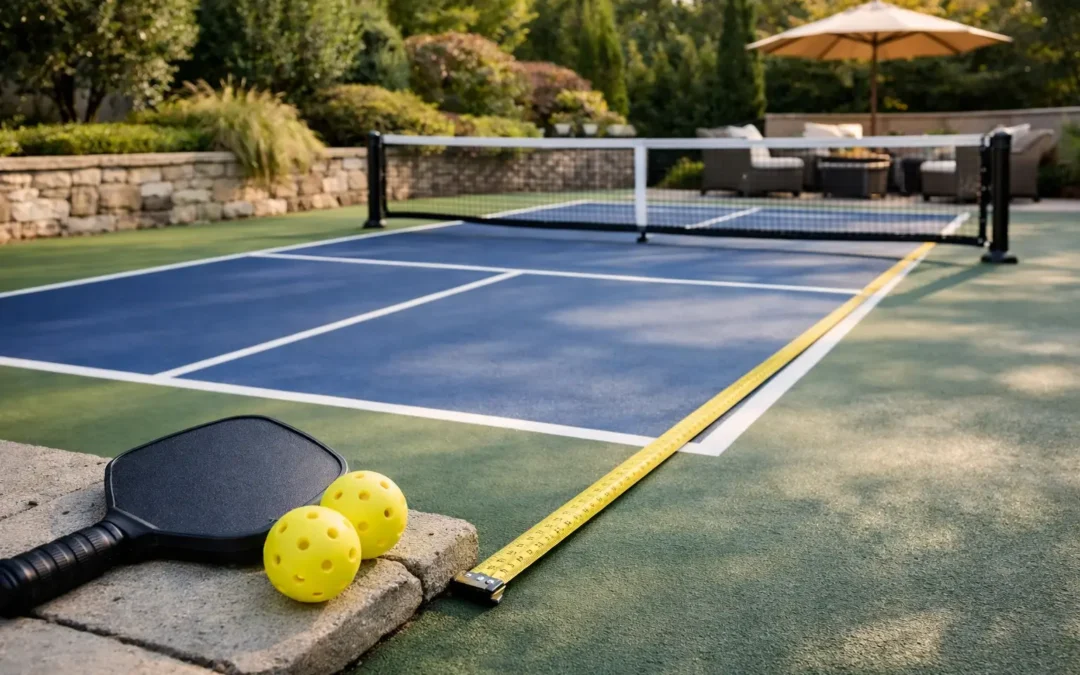
A pickleball court can fit into more backyards than most homeowners expect. But getting backyard pickleball court dimensions right is about more than fitting a 20-by-44-foot rectangle onto a survey. The space around the lines determines whether players can chase a lob safely, serve without hitting a hedge, and enjoy the court as the social centerpiece it should be.
For homes across The Hamptons and Eastern Long Island, the best court plans balance regulation play, property character, drainage, neighboring homes, and the way people actually gather. A court that works beautifully for a family game can also become a favorite setting for clinics, round robins, and summer parties – if it is designed with the full playing experience in mind.
The Official Pickleball Court Size
A regulation pickleball court measures 20 feet wide by 44 feet long, with those dimensions applying to both singles and doubles. The net sits at 36 inches high at each sideline and 34 inches high at the center. Each side of the net has a 7-foot non-volley zone, commonly called the kitchen.
Those painted lines define the court. They do not define the space you need to play well.
For a backyard installation, the preferred total footprint is 30 feet by 60 feet. That gives players roughly 5 feet of room along each sideline and 8 feet behind each baseline. It is the standard we recommend for homeowners who want a court that feels open, safe, and suitable for players at different levels.
A tighter layout can work when a property has real constraints. A practical minimum is often 26 feet by 54 feet, but it comes with compromises. Players will have less room to retrieve deep balls, advanced players may feel crowded, and fence placement becomes especially important. If your goal is occasional recreational play, that trade-off may be reasonable. If you expect competitive friends, regular lessons, or organized events, reserve the larger footprint from the start.
Backyard Pickleball Court Dimensions Beyond the Lines
The 30-by-60-foot recommended footprint is the playing zone, not necessarily the full construction zone. Before choosing a location, account for fencing, gates, walkways, landscaping, seating, and access for equipment during installation.
A fence is typically placed outside the playable area, giving players room to move without colliding with it. For most private courts, 4-foot fencing is enough to keep balls contained while preserving a clean backyard feel. A 6- or 8-foot enclosure may be a better choice where the court sits near a pool, driveway, road, neighboring property, or mature landscaping that makes ball retrieval frustrating.
If you plan to add benches, a viewing area, or a small refreshment station, build that into the layout rather than squeezing it in later. The best backyard courts invite people to stay after the game. A little room beside the enclosure can turn a simple court into a gathering place.
Can You Fit a Court in a Tennis Court Space?
Usually, yes. A standard tennis court is considerably larger than a pickleball court, and it can accommodate multiple pickleball courts depending on the layout. For a residential property, however, converting an existing tennis court is not automatically the right answer.
The surface may have cracks, low spots, drainage issues, or slopes that need attention before new pickleball lines go down. Tennis net posts and fencing can also affect the final layout. A professional site review helps determine whether resurfacing, regrading, or a complete rebuild will deliver the better long-term result.
Give Yourself More Space if You Can
For players who enjoy fast hands battles at the kitchen and deep baseline exchanges, extra clearance changes the quality of play. A 34-by-64-foot footprint is a strong target for serious recreational players, instructors, and hosts who expect a consistent rotation of guests. It allows better pursuit of wide shots and makes the court feel less boxed in.
More space also gives you flexibility. You may want room for a ball machine, a teaching station, or a second portable net during a private event. Players learning the game benefit from a court where they can move freely and reset between drills without stepping into landscaping or a hard fence line.
At Around The Post Pickleball, we have taught more than 3,500 players across skill levels, from first-time guests to 4.0 competitors. One lesson comes up repeatedly: players notice cramped court surroundings immediately. A correct court size is essential. A generous playing envelope is what makes the court feel premium.
Choose the Right Orientation for Sun and Wind
Dimensions are fixed. Orientation is where smart planning makes a major difference.
Whenever the site allows, align the court north to south. That keeps players from routinely serving or returning directly into low morning or late-afternoon sun. In a seasonal community where evening play and weekend entertaining are common, this decision can have a bigger impact than many finish upgrades.
Wind deserves attention, too. Open East End properties can be exposed, especially near the water or in broad, unobstructed yards. Existing hedges, carefully placed landscaping, and compatible screen fencing can reduce gusts without making the court feel enclosed. Avoid placing large trees directly over the court, though. Shade may sound appealing, but falling debris, roots, and persistent moisture create maintenance headaches.
Surface, Slope, and Drainage Matter as Much as Size
A court can be perfectly measured and still perform poorly if the base is not properly built. The finished surface should be smooth, stable, and designed to move water off the court. Even small puddles shorten playing time, accelerate surface wear, and create slippery conditions.
Courts are generally built with a subtle slope to direct water away from the playing area. The exact approach depends on the property, soil conditions, drainage patterns, and whether the court is being built on asphalt or concrete. On Long Island, where groundwater conditions and seasonal weather can vary dramatically from one property to the next, a site-specific plan is worth the effort.
Asphalt is a common choice for private pickleball courts because it can provide a responsive playing surface and is often cost-effective. Concrete can be exceptionally durable but requires careful crack-control planning. Either option needs a properly prepared base. Trying to save money below the surface is one of the fastest ways to create expensive repairs later.
Court color also affects comfort. Medium-to-light playing surfaces can reduce heat and glare compared with very dark finishes, while contrasting boundary colors make the lines easier to see. The goal is a polished court that is comfortable to play on through a long summer afternoon.
Plan for Fencing, Lighting, and Neighbor Considerations
A backyard pickleball court is active by design. The sound of paddles, conversation, and friendly competition is part of the appeal, but a thoughtful plan respects the homes around it.
Position the court with reasonable distance from neighboring windows and outdoor living areas when possible. Consider acoustic fencing or landscape buffers if nearby properties are close. Establishing play hours is also a simple, neighbor-friendly move, particularly in quiet residential areas.
Lighting extends the value of the court, especially for hosts who want post-dinner play. Fixtures should illuminate the court evenly without shining into neighboring yards. Poorly placed lights create glare for players and complaints for everyone else. A professional lighting layout puts the fixtures outside the playing area and focuses illumination where the ball travels.
Do not forget access. Players should be able to enter through a gate wide enough for maintenance equipment and construction crews. A clear path from the house, pool area, or driveway makes the court easier to use and easier to care for.
Build for the Way You Will Actually Play
The right dimension is not always the biggest dimension on paper. A compact court tucked into a well-designed landscape may be the perfect solution for a family that wants casual games. A larger 30-by-60-foot or 34-by-64-foot layout makes more sense for homeowners who want lessons, competitive play, or a reliable venue for entertaining.
Before finalizing your plan, stand in the proposed court area and picture the full experience: players moving behind the baseline, guests watching from the side, balls traveling beyond the kitchen, and a summer evening match that runs longer than expected. If the space supports that picture comfortably, you are not just building a court. You are creating a reason for people to come together and play again tomorrow.