
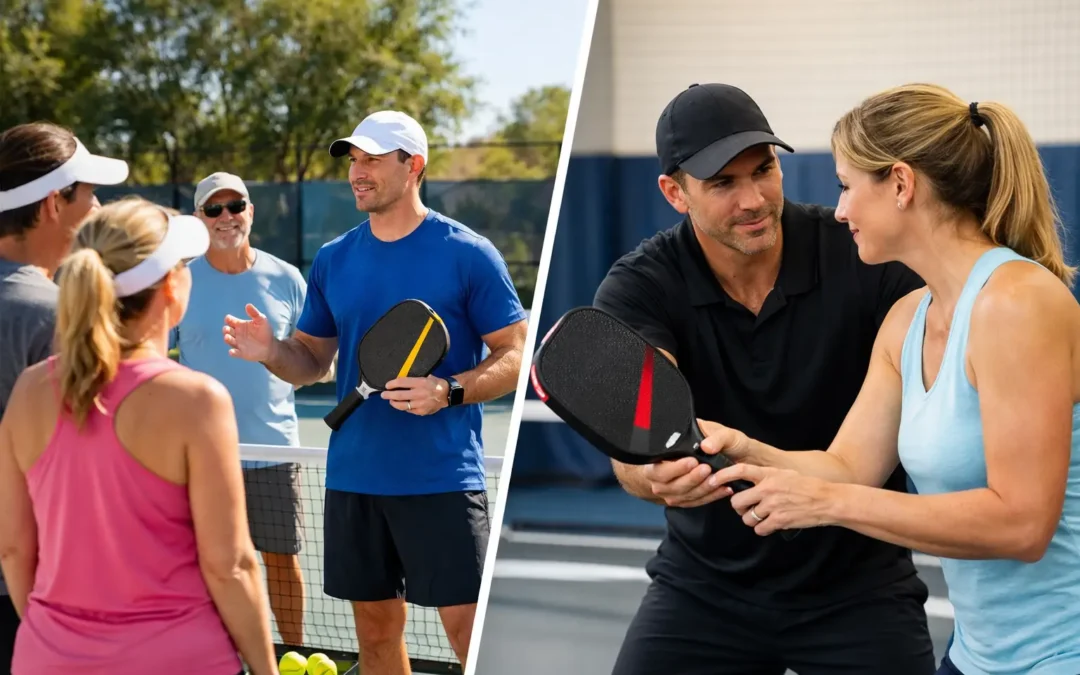
A great pickleball camp or clinic can change more than your stroke mechanics. It can turn uncertain third-shot drops into reliable decisions, help you find better partners, and make walking onto a busy local court feel far less intimidating. The right choice comes down to how you learn, what you want to improve, and how much court time you can commit to.
For players in the Hamptons and across Eastern Long Island, both formats offer meaningful value. But they are built for different moments in a player’s development. A clinic gives you a focused session on a specific part of the game. A camp creates more time for repetition, coaching feedback, match play, and connection with a new group of players.
What Is the Difference Between a Pickleball Camp or Clinic?
A pickleball clinic is typically a shorter, structured instructional session, often lasting 60 to 120 minutes. Players work with a coach on one theme, such as serving and returning, dinking patterns, transition-zone footwork, volley technique, or the third-shot drop. Clinics are ideal when you want targeted instruction without setting aside an entire day or weekend.
A camp is a more immersive experience. It may run for several hours, a full day, or multiple days and usually combines technical instruction, movement drills, strategy, coached play, and social time. Because instructors see players over a longer window, they can identify habits that do not show up in a quick warm-up and help players apply new skills under game pressure.
Neither format is automatically better. A player with one clear weakness may get faster results from a clinic. A player preparing for a tournament, returning to the sport after time away, or looking to make a real jump in confidence may benefit more from a camp.
Choose a Clinic for Focused, Immediate Improvement
Clinics work best when your goal is specific. Maybe your drives are strong but your soft game falls apart at the kitchen line. Maybe you understand stacking in theory but cannot communicate it smoothly with a partner. Maybe you are brand-new and need a welcoming first lesson that covers scoring, positioning, and the basics without feeling overwhelming.
The strongest clinics keep groups appropriately matched by level. A 3.5 player needs different feedback than a first-time player, and mixed-level groups can limit repetitions if they are not managed well. Look for a format that makes clear who it is designed for, how long the session runs, and whether the coach will give individual feedback.
For many busy adults, the schedule is the biggest advantage. You can take a focused evening or morning clinic, play socially later in the week, and return for another topic when you are ready. That steady rhythm is effective because pickleball improvement comes from a cycle of instruction, practice, and correction – not from collecting tips and hoping they stick.
A clinic is also a smart way to evaluate coaching. You should leave with one or two clear changes to work on, not a crowded list of contradictory thoughts. Quality instruction simplifies the game: where to stand, what ball to attack, when to reset, and how to build a higher-percentage point.
Clinic topics that deliver real value
The most useful clinic themes connect technique to decisions. A session on dinking should cover more than keeping the ball low. It should teach players how to move an opponent, recognize an attackable ball, recover after a speed-up, and stay patient when the point calls for patience.
The same is true for serving, returns, and the third shot. Mechanics matter, but so does understanding the next ball. A return that lands deep is valuable because it buys time to reach the kitchen line. A drop is valuable because it helps a team move from defense into a neutral point. Strong clinics make those connections clear.
Choose a Camp for Reps, Strategy, and Momentum
A camp gives players something hard to recreate in casual open play: concentrated time with a plan. Instead of waiting between games or playing points that repeat the same old patterns, participants move through purposeful drills, coached scenarios, and live games designed to reinforce the day’s lessons.
That extra time matters. Players often understand a correction after hearing it once, then lose it when the pace rises. At camp, coaches can revisit the same skill across multiple progressions. You might begin by practicing a compact volley in a controlled drill, then use it in a kitchen-line exchange, then apply it during a competitive game. That is where a new skill begins to hold up.
Camps are especially valuable for intermediate and advanced recreational players who want a more complete view of their game. At the 3.0 to 4.0 level, improvement is rarely about one magic shot. It is about recognizing patterns, reducing unforced errors, moving efficiently with a partner, and knowing when not to force an attack.
A well-run camp also creates a better social experience than unstructured play. You spend enough time with the same group to build rapport, learn who complements your game, and leave with new people to play with. In a seasonal community, that sense of connection can be as valuable as the instruction itself.
What a quality camp should include
The best camps balance teaching with doing. Too much lecture time leaves players standing around. Too much play without intervention can turn a camp into expensive open play. Look for a schedule that includes skill development, tactical drills, movement and positioning, coached games, and time to ask questions.
Instructor credentials and group management matter, too. Certified professionals bring a teaching framework, but the real test is whether they can organize a court, give useful feedback, adjust a drill, and make every player feel seen. Around The Post Pickleball has taught more than 3,500 players with IPTPA-certified instructors and added PPR certification depth, bringing that professional structure to programs built for local players at every stage.
Match the Format to Your Current Goal
If you are a beginner, start with a fundamentals clinic unless you want a full immersion experience. You need a clear introduction to safety, scoring, court position, paddle control, and etiquette before fast-paced play becomes enjoyable. A beginner camp can be an excellent option when it is intentionally designed for newcomers, with enough coaching support and no expectation that you already know the game.
If you are an intermediate player, decide whether your challenge is narrow or broad. Choose a clinic if you need help with one area, such as backhand dinks or defending hard drives. Choose a camp if your issue is consistency across the entire game – perhaps you play well in practice but struggle with shot selection, partner movement, or closing matches.
Tournament-minded players often benefit from camp settings because they can train the transitions between skills. Tournament points expose weak communication, rushed resets, poor return depth, and unreliable decision-making. Drill-heavy work followed by coached competition helps expose those gaps before they matter in a bracket.
If your goal is primarily social, do not dismiss instruction. A beginner-friendly clinic or social camp is one of the most comfortable ways to meet players with a shared interest. The key is choosing an experience that protects the fun while still providing enough structure to make everyone better.
Questions to Ask Before You Register
Before committing, ask whether the program is matched by skill level, how many players will be on each court, and what the coaching-to-player ratio looks like. Ask whether drills lead into live play and whether instructors provide individual feedback. These details shape the experience more than a flashy program name.
Also consider the venue and the conditions. Outdoor pickleball in the Hamptons can bring wind, heat, glare, and changing weather. A professionally operated program should communicate clearly about timing, court setup, weather plans, and what players should bring. You want to arrive ready to play, not spend the first half hour figuring out logistics.
Finally, be honest about your learning style. Some players thrive with a regular one-hour clinic that gives them a single mission for the week. Others need the energy and repetition of a camp to break through a plateau. The best investment is the one you will follow with purposeful play afterward.
Bring curiosity, a willingness to make mistakes, and a specific goal for your next session. Whether you choose a camp or a clinic, that mindset gives every coached ball a chance to become a better point when it counts.