
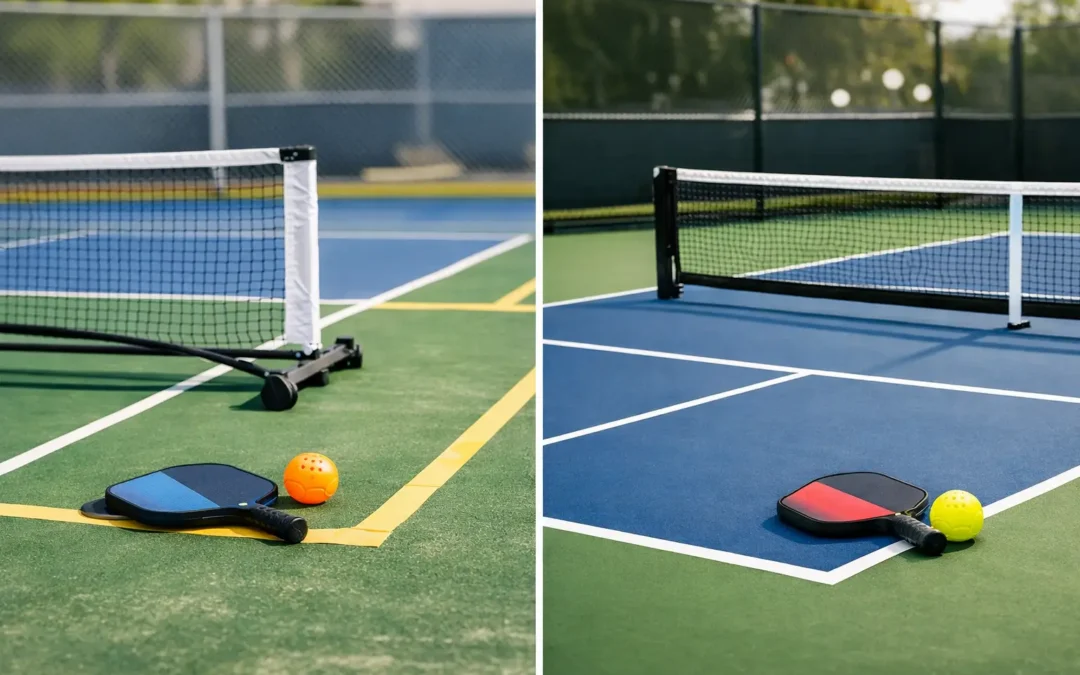
A great pickleball experience can start in a driveway, on a tennis court, or inside a gym. But temporary versus permanent pickleball courts is not simply a question of budget. It is a decision about how often people will play, who will use the space, what kind of experience you want to create, and whether the court needs to work as a long-term amenity or a flexible event feature.
For homeowners, clubs, schools, resorts, and event hosts across The Hamptons and Eastern Long Island, both options can make sense. The better choice comes from matching the court to the way your community actually plays.
What Makes a Court Temporary or Permanent?
A temporary court uses an existing surface. It may be created with removable court tape, painted lines approved by a facility, a portable net system, and movable barriers or seating. Tennis courts, basketball courts, gym floors, driveways, patios, and event spaces can all become playable pickleball areas when the dimensions and surface are appropriate.
A permanent court is built or converted for regular pickleball use. That can mean a dedicated asphalt or concrete court with a pickleball color system, fixed net posts, fencing, lighting, drainage, windscreens, and sometimes seating or shade. A permanent tennis-court conversion can also fall into this category when the layout, striping, nets, and surrounding amenities are designed for ongoing pickleball play.
The playing lines are the same either way: a pickleball court measures 20 by 44 feet. The surrounding space is where projects begin to differ. A recreational setup should generally allow roughly 30 by 60 feet, while players who expect faster, more competitive play benefit from a larger footprint. Chasing balls into landscaping, walls, chairs, or another active court changes the game quickly.
Temporary Versus Permanent Pickleball Courts: The Real Trade-Off
Temporary courts win on speed and flexibility. Permanent courts win on consistency, play quality, and long-term value. Neither is automatically better.
A temporary setup is often the smart starting point for a host who is testing demand. Maybe a country club wants to see whether members will join a weekly round robin. Maybe a corporate team wants a social activity that is more active than a cocktail hour. Maybe a homeowner is planning a summer party where guests range from first-timers to experienced players. A professionally organized temporary setup can create a real pickleball atmosphere without committing to construction.
The limitation is that a temporary court requires attention every time it is used. Lines need to be straight and secure. Portable nets need the correct height and tension. The surface needs to be safe, clean, and dry. Players also notice when courts are too close together or when there is no clear place to wait between games. For a one-day event, that effort is worthwhile. For daily play, it can become a recurring hassle.
Permanent courts require more planning up front, but they eliminate much of that friction. Players arrive to a court that is ready. The lines are precise. Nets are stable. Fencing helps keep games moving. Proper surfacing and drainage protect the investment and make the court more dependable after weather changes. For a family property, private community, club, or hospitality venue, that reliability often becomes the difference between an occasional activity and a true gathering place.
When a Temporary Court Is the Better Move
Temporary courts are especially effective when the goal is access, experimentation, or a high-energy event. They allow organizers to bring pickleball to people rather than waiting for people to find a dedicated facility.
For private parties, portable courts can turn a lawn-adjacent hard surface, tennis court, or indoor area into a centerpiece. The best events do more than place a net in the middle of the space. They use clear court layouts, appropriate paddles and balls, structured rotations, and instruction that gets beginners rallying quickly. That matters when guests have different athletic backgrounds and limited time.
They also work well for clubs and municipalities that need to understand utilization before building. If open play is full every week, clinics develop a waiting list, and members request more court time, the demand is no longer theoretical. A temporary program has produced useful evidence for a permanent project.
Indoor facilities have their own reason to choose temporary courts. Multi-use gym floors and field houses often need to serve several sports. Removable nets and carefully applied temporary lines keep pickleball available without taking over the building. In those cases, operational discipline matters more than construction.
A temporary court is less appealing when the surface is uneven, slick, cracked, or heavily sloped. It is also a poor fit for frequent advanced play. Competitive players put more pressure on the playing area with quick lateral movement, hard stops, and wider pursuit of balls. A court that is acceptable for a casual introductory session may not be suitable for drill-heavy clinics or tournament-level competition.
When a Permanent Court Earns Its Cost
A permanent court is an investment in repeat use. It makes the most sense when pickleball is part of the lifestyle or programming plan, not a one-off attraction.
At a residence, a dedicated court can create a reason for friends and family to gather. At a club, resort, school, or community, it can support scheduled lessons, leagues, clinics, junior programming, open play, and events. The court becomes more valuable as the programming around it improves.
That is why construction decisions should begin with use, not just appearance. A beautiful court with poor orientation, limited runoff space, or no plan for player traffic will underperform. A thoughtfully designed court considers the sun, drainage, nearby trees, wind, neighborhood sound, parking, access, and the number of players expected at peak times.
On Eastern Long Island, weather deserves special attention. Freeze-thaw cycles, rain, humidity, coastal conditions, and seasonal use all affect surface preparation and maintenance. Proper base work and drainage are not decorative upgrades. They help protect the playing surface and reduce the frustration of puddling, cracking, or premature wear.
Fencing is another decision that changes the day-to-day experience. It keeps balls from rolling into other games, roads, pools, or landscaping, and it speeds up play. Lighting can extend a court’s usefulness into evening hours, but it should be planned responsibly with the property, neighbors, and local requirements in mind. These details add cost, yet they are often the details players appreciate most after the court opens.
Do Not Compare Costs by Construction Alone
The upfront cost of a temporary setup is usually far lower, but the full value calculation goes beyond the initial purchase or build. Consider staff time, setup and breakdown, equipment storage, surface repairs, programming, and how often the court will actually be used.
A portable net that is constantly moved, adjusted, stored, and replaced has a cost in time. So does a tennis court that becomes crowded because pickleball programming has outgrown its available slots. Conversely, a permanent court that sits unused for most of the year may be more infrastructure than a property needs.
For many organizations, the practical answer is phased growth. Start with well-run temporary play, track participation, offer beginner sessions and organized competition, then build when demand is established. For others, particularly properties where pickleball is a signature amenity from day one, building correctly at the start avoids a second round of disruption later.
Play Quality Depends on More Than the Net
Players can enjoy pickleball on a temporary court, especially when the setup is professional and the group is well organized. Still, permanent courts create a more predictable playing environment. The ball bounce is more consistent, line calls are clearer, and players can move with greater confidence.
This is particularly relevant for instruction. Beginners need a welcoming space where they can focus on learning the serve, return, scoring, dinking, and safe movement. Intermediate and advanced players need room for footwork, transition-zone drills, third-shot work, and live point play. Around The Post Pickleball has taught more than 3,500 players, and one lesson is clear: the right environment helps players progress faster and enjoy the process more.
The surface also affects sound. Pickleball has a distinctive pop, and that should be part of any permanent-court conversation in residential areas. Court placement, fencing, landscaping, scheduled hours, and thoughtful communication all help. A court should add energy to a property without creating avoidable tension nearby.
Choose Based on the Experience You Want to Deliver
If you need flexibility, are planning a special event, share a multi-sport facility, or want to test local interest, a temporary court can be an excellent solution. Invest in quality portable equipment, safe spacing, clear lines, and experienced event management. A temporary court should still feel intentional.
If you expect regular play, want to build a pickleball community, or are creating a premium residential or club amenity, a permanent court will usually deliver more value over time. Plan the footprint, surface, drainage, access, fencing, and programming together rather than treating construction as a standalone project.
The best court is the one that gets people playing confidently, often, and together. Build for that moment – whether it begins with a portable net for Saturday’s party or a dedicated court that becomes the most social corner of the property.