
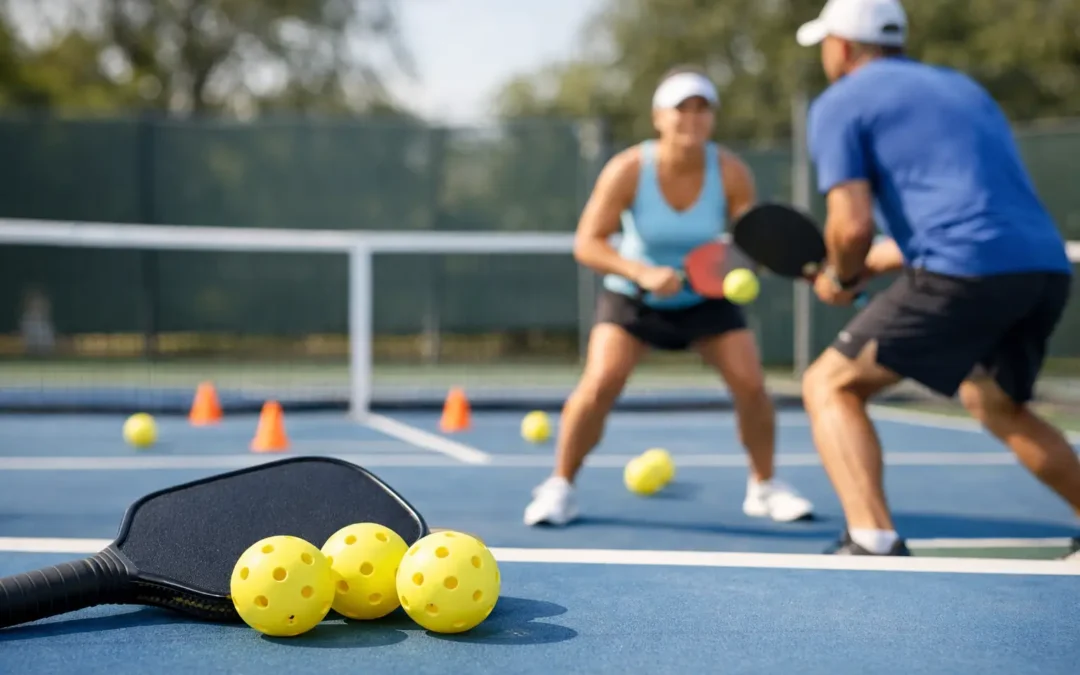
The point you miss at 9-9 rarely comes down to whether you know the rules. It comes down to whether your third shot lands in the right place, whether you can absorb a hard drive, and whether you recognize the ball you should attack. The best pickleball drills for intermediates build those decisions into repetition, so your game holds up when a friendly match gets competitive.
Intermediate players do not need random reps. They need purposeful patterns that sharpen the transition zone, improve consistency at the kitchen line, and turn good mechanics into better choices. At Around The Post Pickleball, our certified instructors have taught more than 3,500 players across the Hamptons and Eastern Long Island, and the same theme comes up again and again: players improve faster when each drill has a clear target, scoring system, and game-day purpose.
What Intermediate Players Should Actually Train
At this level, you can usually keep a rally going and make the occasional winning shot. The next jump is about reducing unforced errors while creating pressure without rushing. That means training the parts of the game that decide most competitive recreational points: dinking with intention, dropping or driving the third ball, resetting from the transition zone, and recognizing when an attack is truly available.
A productive drill should ask more of you than simply making ten balls in a row. Add a target, a movement pattern, a constraint, or a consequence for a mistake. Repetition matters, but deliberate repetition matters more.
1. Crosscourt Dink With a Moving Target
Start crosscourt at the kitchen line. Place a cone, paddle cover, or flat marker about two feet inside the kitchen and a few feet from the sideline. Both players dink crosscourt, trying to land the ball near the target while keeping it unattackable.
After five successful dinks, one player may move the opponent with a wider ball. The other player must recover to a balanced position before sending the next ball back crosscourt. This is not a speed contest. The goal is to control height, depth, and direction without giving away a pop-up.
Run three rounds of two minutes, then switch sides. For intermediate players, the backhand crosscourt dink deserves extra attention because it appears constantly in doubles and exposes rushed footwork quickly.
2. The Dink-to-Attack Decision Drill
Many players know they should be patient at the kitchen line. Fewer know when patience should end. This drill teaches that distinction.
Begin with a cooperative crosscourt dink rally. Either player may speed up only a ball that sits above net height or drifts too far into the kitchen. The opponent’s job is to counter safely to the middle, down at the attacker’s feet, or back into the dink exchange. A speed-up on a low ball counts as an error, even if it goes in.
Play first to seven points, but award a point only when the attack came from a legitimate opportunity or when the defender earns the rally back with a controlled counter. You will start seeing the difference between an aggressive shot and a reckless one.
3. Third-Shot Drop Ladder
A third-shot drop is not one shot. Its required height, spin, and placement change based on return depth, wind, court surface, and your opponents’ position. The ladder drill gives you volume without removing that context.
Have one player return serves from the baseline while the other practices third-shot drops from behind the baseline. Start with a large landing zone in the middle third of the kitchen. Make three drops that clear the net comfortably and bounce before the receiver can volley them. Then narrow the goal: three to the backhand side, three to the forehand side, and three that pull the opponent slightly wide.
If you miss, repeat that level. Do not chase a perfect drop that barely clears the tape. A useful third-shot drop buys you time to move forward, even if it lands a little deeper than planned. Once both players are making consistent drops, allow the return team to volley or take the ball out of the air. That is where the drill starts to feel like a real point.
4. Drive, Drop, or Drip From the Baseline
Intermediate players often choose their third shot before the serve return is even struck. Instead, train the read.
One player returns serves from varying locations: deep middle, deep crosscourt, shorter angle, and occasionally a ball that sits up. The serving player must call out “drop,” “drive,” or “drip” immediately after the bounce, then play that shot. A drop is the default against a deep, controlled return. A drive can make sense when the ball is higher or when it can target the returner’s body. A drip – a softer, more controlled drive that drops into the kitchen – can be effective when opponents are leaning back or leaving space in front of them.
The partner should give honest feedback: Was the choice right? Did the shot create a manageable fifth ball? The best option depends on the return and the opponents, not on a fixed preference for one style of play.
5. Transition-Zone Reset Challenge
The transition zone is where rallies get uncomfortable. You are close enough to be attacked but not close enough to volley with confidence. This drill helps you stop treating every fast ball as something to fight.
Set one player in the transition zone and the other at the kitchen line with a supply of balls. The kitchen-line player feeds controlled drives at the transition player’s feet, hips, and backhand side. The transition player must reset each ball softly into the kitchen, preferably crosscourt or to the middle, then take one balanced step forward.
Count how many quality resets you make out of ten. A quality reset clears the net, lands in the kitchen, and gives the opponent no easy put-away. If the feed is too hard to control, slow it down. The purpose is clean technique: loose grip pressure, compact swing, stable paddle face, and legs doing the work. Add pace only after the reset is reliable.
6. Two-Up, Two-Back Pressure Points
This is one of the best pickleball drills for intermediates because it connects the third shot, transition, and kitchen-line play in one competitive pattern. Start with one team at the baseline and one team at the kitchen line. Feed the ball to the baseline team, and play out the point.
The baseline team earns two points for winning the rally after both partners reach the kitchen line. They earn one point for winning before getting there. The kitchen team earns one point for any win, but loses a point if both opponents establish at the line without pressure.
This scoring forces the back team to work together rather than sprint forward blindly. It also teaches the kitchen team to attack the right ball while keeping the baseline team from settling into an easy rhythm. Rotate every eight to ten points.
7. Middle-Ball Communication Drill
A surprising number of intermediate points disappear between partners. The ball lands in the middle, both players hesitate, and the rally ends with a frustrated glance. Fix that with direct, repetitive communication.
Stand at the kitchen line with a partner while two opponents or a coach feed balls to the middle seam. Before every ball, the receiving team must call “mine,” “yours,” or “middle.” The player taking the ball should aim toward the opponent’s weaker side or through the middle, then recover to a connected position with their partner.
Make the drill harder by alternating dink feeds, body shots, and balls that pull one player wide. The point is not merely calling the ball. It is learning who has the forehand, who has better balance, and when the middle is the safer reply.
8. Seven-Ball Point Construction
This final drill rewards patience. Begin a normal doubles point, but neither team may attempt an aggressive speed-up until the seventh shot of the rally. That rule removes the urge to force a winner early and makes players earn an attack through placement, movement, and consistency.
After several rounds, change the rule: a speed-up is allowed earlier only if the ball is above net height. You will quickly see which players are manufacturing attackable balls with sharp dinks and which are simply waiting for errors. Both can win a point, but only one approach travels well into stronger competition.
Turn Drills Into Better Match Play
Choose three drills for a 60- to 90-minute session rather than trying to cover everything. A strong weekly plan might include one kitchen-line drill, one third-shot or transition drill, and one game-based drill. Track a simple result such as successful resets out of ten, third shots that allow a move forward, or points won after a controlled attack.
Bring the same focus into your next open play session. Pick one intention before you step on court: reset more balls instead of countering from the transition zone, attack only balls above net height, or call every middle ball early. Measurable improvement comes from carrying one trained habit into live points, then giving it enough matches to become automatic.