
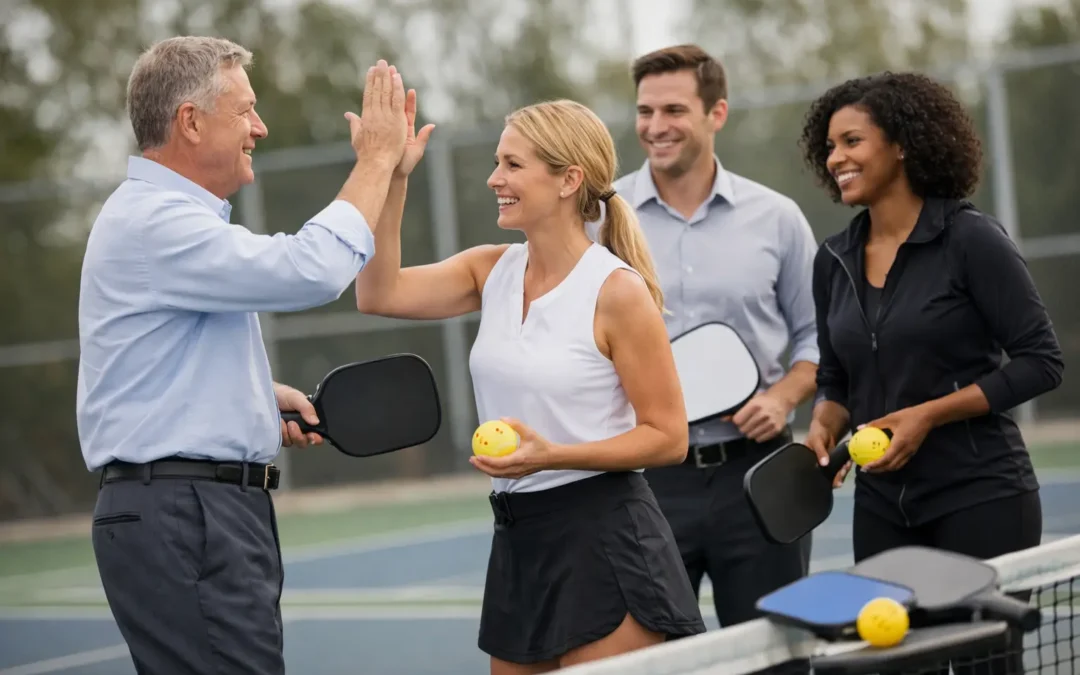
A corporate pickleball event succeeds or fails before the first serve. Put a room full of mixed abilities into open play with no structure, and confident players take over while beginners drift to the sidelines. Choose the best pickleball format for corporate groups, and that same group starts talking, moving, competing, and cheering together within minutes.
For most companies, the answer is not a traditional tournament. The strongest format is a team-based, timed round robin with rotating partners, short games, and a clear championship finish. It creates enough competition to feel exciting without making the day intimidating for employees who picked up a paddle for the first time at the event.
Why traditional brackets often miss the mark
A single-elimination bracket works when every player arrives ready to compete and has a similar skill level. That is rarely the reality at a corporate outing. One department may include former tennis players, regular pickleball players, and total beginners. Another may have colleagues who came primarily for the social experience.
In an elimination format, a team can travel to a beautiful Hamptons or Eastern Long Island venue, play one short match, lose, and spend the rest of the event watching. That is not a great return on time, travel, or team-building investment. It also creates a familiar office dynamic: the most athletic few get the spotlight while everyone else becomes an audience.
Corporate events need repeated participation, easy entry points, and enough structure that nobody has to wonder where to go next. The format should reward teamwork and enthusiasm as much as clean third-shot drops.
The best pickleball format for corporate groups: team round robin
A team round robin gives every participant multiple matches and keeps the event moving at a pace that feels organized but relaxed. Divide attendees into balanced teams, usually distinguished by color, company department, or a playful team name. Then rotate pairs through timed games against different opponents.
Instead of requiring every person to understand a full tournament draw, the event leader posts a simple court schedule. Players report to their assigned court, play for a set period, record their score, and move to the next round. A typical game window is 10 to 15 minutes, depending on the number of courts and participants.
The key is cumulative scoring. Each game contributes points to the larger team total, so every rally matters even if a pair is behind. A beginner who wins three extra points for their team has made a meaningful contribution. That shared objective changes the energy quickly. Coworkers support one another, stronger players offer advice, and people who have not worked together suddenly have a reason to connect.
At Around The Post Pickleball, our event experience has shown that this format is especially effective when groups include a broad range of ages, athletic backgrounds, and pickleball familiarity. It is competitive enough for experienced players and welcoming enough for the colleague who was initially hesitant to step on court.
Keep partners rotating
Rotating partners is one of the easiest ways to make a corporate event feel genuinely inclusive. If players remain with the same partner all afternoon, skill gaps can become more obvious and social circles can stay fixed. Change partners every round, ideally pairing experienced players with newer players when possible.
This approach also prevents one dominant duo from determining the entire event. More importantly, it gets people talking across departments. A finance executive may play alongside a marketing coordinator in one round and face them in the next. That is the point: pickleball creates low-pressure interaction that a seated lunch or standard happy hour rarely produces.
Use timed games, not win-by-two pressure
Timed games are better than traditional win-by-two scoring for most corporate groups. When the horn, music cue, or organizer call ends the round, every court stops together and the next rotation begins. Nobody is left waiting while one court battles through a long deuce game.
For a social corporate event, play games to 11 or use rally scoring for a fixed 12-minute period. Rally scoring means a point is awarded on every rally, which is simple to follow and keeps newer players engaged. For more experienced groups, traditional side-out scoring may feel more familiar, but it can create uneven match lengths. The right choice depends on the group, though timed rounds should remain the foundation.
Build the event around skill, not assumptions
The best format still needs the right on-court setup. Before competition begins, give the group a concise clinic led by certified instructors. Cover safety, court positioning, serving, scoring, and the kitchen line. Then run a few fast, approachable drills that let everyone make contact with the ball and experience a successful rally.
This is not dead time before the main event. It gives beginners the confidence to participate and helps experienced players settle into the rules and expectations of the day. A quality warmup also reduces the chance that one player starts coaching their partner mid-match in a way that feels unhelpful.
For groups with major skill differences, use a hybrid format. Keep recreational players in the main team round robin, then offer a designated advanced court or an optional championship division later in the event. That allows stronger players to test themselves without turning the whole day into a performance gap.
A corporate format that works by group size
There is no single court plan for every headcount. The best event design depends on attendance, available courts, time, and whether the goal is team building, client entertainment, or a more competitive company championship.
For 12 to 20 players, a compact team round robin works beautifully on two to three courts. Players can rotate frequently, and an organizer can keep the day personal and energetic. A 90-minute to two-hour program typically allows for instruction, several rounds, and a final.
For 20 to 48 players, create four to six teams and use a color-coded schedule. This is the sweet spot for a full corporate pickleball experience: enough people for real team spirit, but not so many that participants lose track of the action. If courts are limited, establish a comfortable hospitality area with refreshments, seating, and a clear view of play so short breaks still feel like part of the experience.
For groups larger than 48, use team captains, staggered court rotations, and event stations. One group may be playing while another is in a skills challenge, taking part in a serving contest, or enjoying a brief coaching session. The goal is to avoid long inactive stretches. Large events need professional tournament operations, visible schedules, and an experienced event lead to keep the pace sharp.
Finish with a final worth watching
A format needs a finish. After round-robin play, send the top two or four teams into a short playoff while the rest of the group stays involved. The final can be played by selected representatives, by a rotating set of teammates, or through a relay-style points challenge that lets more people participate.
Keep the tone celebratory. Announce team standings, recognize standout effort, and include awards that go beyond first place. Best teammate, most improved player, strongest rally, and team spirit awards often get the biggest reaction. They also reinforce the behavior companies want from the event: encouragement, collaboration, and a willingness to try something new.
A championship moment matters because it gives the day a story. Employees remember the surprise comeback, the executive who made their first serve, and the department that showed up in full team colors. Those moments are more valuable than a perfectly formal bracket.
Details that make the format feel premium
Corporate groups notice the difference between casual court time and a professionally produced experience. Clear pre-event communication, balanced teams, instructor-led orientation, quality equipment, visible scoring, and a dedicated event host all remove friction from the day.
The setting matters, too. In The Hamptons and across Eastern Long Island, pickleball can be the centerpiece of a company retreat, a summer client event, or an employee appreciation afternoon. Add thoughtful hospitality, music, photography, and custom team branding when the occasion calls for it. But keep the game itself accessible. The best events feel polished without feeling overproduced.
If your group is highly competitive, increase the intensity with seeded divisions and a true playoff. If the goal is connection, prioritize mixed teams, rotating partners, and fun scoring incentives. A format should fit the people in the room, not force them into a tournament designed for a different audience.
The right corporate pickleball event leaves people with more than a scorecard. It gives coworkers a shared win, a new conversation, and the confidence to come back on court together.