
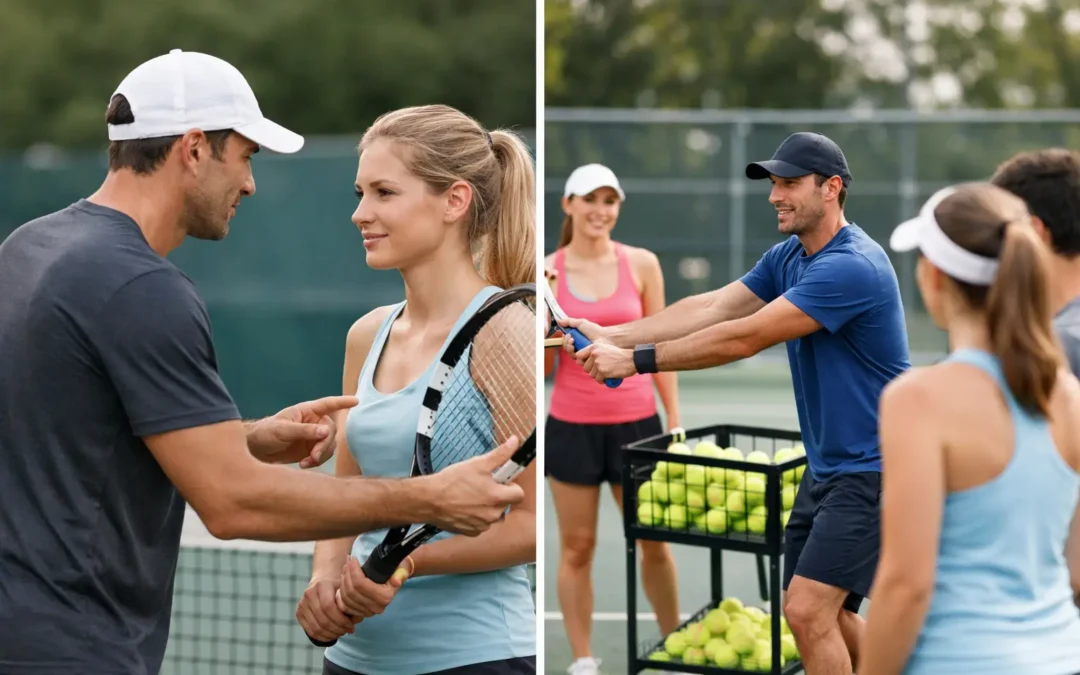
Some players want one clear thing from a lesson: fix my third-shot drop, clean up my footwork, and help me stop popping up volleys. Others want reps, energy, and a group that makes practice feel like part training session, part social hour. That is why private lessons vs group clinics is not a simple either-or question in pickleball. The right choice depends on how you learn, what you need to improve, and how quickly you want feedback to turn into better play.
In a market like the Hamptons and Eastern Long Island, players are not just looking for court time. They are looking for structure, coaching quality, and a program that actually moves their game forward. Whether you are brand new or pushing toward more competitive play, the format matters.
Private lessons vs group clinics: what really changes?
At the most basic level, private lessons give you individualized coaching. Group clinics give you shared instruction in a structured setting with other players at a similar level. That sounds obvious, but the real difference shows up in how each format handles attention, repetition, pressure, and learning speed.
In a private lesson, every minute is built around your game. If your serve return is short, that becomes the focus. If you are struggling with transition zone decision-making, the coach can slow it down, isolate the pattern, and keep working until it clicks. There is very little wasted time because the session adapts to you in real time.
In a group clinic, the value comes from a different place. You still get professional coaching, but you are learning inside a broader structure. That means shared drills, live-ball scenarios, and seeing how other players solve the same problems. For many adults, that environment feels more natural and more fun. It also mirrors how pickleball is actually played – with other people, under a little pressure, while making decisions on the fly.
When private lessons make the most sense
Private instruction is usually the fastest path when a player has a specific issue that keeps showing up in matches. Maybe your dink breaks down under pressure. Maybe you are late getting to the kitchen line. Maybe you have enough experience to know exactly where your game leaks points, but you cannot self-correct.
That is where one-on-one coaching shines. A certified instructor can spot patterns quickly, connect the mistake to the underlying cause, and give you drills that match your mechanics, not someone elses. For adult learners, that kind of targeted feedback can save months of frustration.
Private lessons also work well for beginners who feel overwhelmed in group settings. Some new players do not want to learn scoring, grip, court positioning, and strategy while keeping up with a class. They want space to ask basic questions without feeling behind. A private lesson can build comfort quickly, especially for players who are athletic but new to racket sports, or social players who want a smoother first step into the game.
Advanced recreational players often benefit from privates for a different reason. Once you reach a certain level, improvement gets more specific. General tips are no longer enough. You need sharper feedback on shot selection, anticipation, partner movement, and how to win points against stronger opponents. Private coaching helps tighten those details.
The trade-off is cost. Private lessons ask for a bigger investment per session. They can also be more intense. Not every player wants 60 minutes of direct correction, especially if pickleball is a major social outlet as much as a performance goal.
When group clinics are the better fit
Group clinics are often the smartest starting point for players who want quality instruction, lots of reps, and a strong sense of community. A well-run clinic is not random open play with a few tips mixed in. It should be organized by level, built around a clear training objective, and paced so players are active instead of standing around.
That format is ideal for developing broad fundamentals. If you need to improve consistency, court awareness, kitchen play, serving, returns, and partner communication all at once, clinics can create a more complete learning environment. You see concepts demonstrated, you practice them repeatedly, and then you test them in live scenarios with different people.
There is another advantage that matters more than many players realize: group clinics teach adaptability. In a private, the coach is reading you. In a clinic, you also have to read others. Different speeds, different habits, different strengths. That kind of variability helps players become more game-ready.
For many adults in the Northeast pickleball scene, clinics also make the sport stick. They combine instruction with the social side that keeps people coming back. You improve, meet players at your level, and build confidence before jumping into rec play, leagues, or tournaments. That matters because consistency beats intensity over time.
The trade-off is that clinics cannot revolve around one player. If your backhand block needs serious repair, a clinic may expose the problem, but it may not give you enough individualized correction to fix it quickly. You are sharing the coachs attention, and the lesson has to work for the whole group.
Skill level matters, but not in the way most people think
Many players assume beginners should start in clinics and advanced players should book privates. Sometimes that is true, but not always.
A true beginner who is nervous, unsteady on scoring, or unsure about basic movement may progress faster in one or two private sessions before joining a clinic. That foundation can make group training much more comfortable.
On the other hand, a solid intermediate player who already has decent mechanics may get huge value from clinics if the class is well matched by level and focused on the right themes. They may not need constant one-on-one correction. They may need repetition, pressure, and pattern work.
Even competitive players should not assume private always wins. If you are preparing for doubles play, there is real value in drilling with others, competing for balls, and adjusting to live situations. Some of the best improvement plans blend both formats because each solves a different problem.
Budget, schedule, and learning style all play a role
The best format on paper is not always the best format for your life. If your schedule is tight and you want maximum efficiency, a private may deliver more in less time. If you want regular training without the higher per-session cost, clinics may be the more sustainable option.
Learning style matters too. Some players thrive on direct feedback and technical detail. Others improve best when they can watch, imitate, compete, and absorb the lesson in a more social setting. Neither is better. The key is choosing the format that helps you stay engaged long enough to improve.
This is especially true for adult players balancing work, family, travel, and seasonal routines. The most effective program is the one you will actually commit to.
A smarter answer: use both at the right time
For many players, private lessons vs group clinics is not a final choice. It is a sequencing question.
A strong path might start with a private lesson to assess mechanics and build a foundation. Then a player moves into clinics for repetition and live application. Later, they book another private to fine-tune weak spots that show up in match play. That approach gives you both precision and volume.
This is one reason structured programming matters. When coaching is organized by level and led by certified instructors, players do not have to guess what they need next. They can move from intro instruction to clinics, drilling, competitive play, and event-based experiences with a clear sense of progress. That is where experienced operators stand apart from casual lesson providers.
Around The Post Pickleball has built that kind of progression by teaching more than 3,500 players across the region, from first-timers to stronger recreational competitors. That breadth matters because good coaching is not just about feeding balls. It is about placing players in the right environment at the right stage.
How to decide what to book first
If you want one practical rule, use this: choose private lessons when your biggest need is personal correction, and choose group clinics when your biggest need is structured repetition and live play.
If you are still unsure, ask yourself a few honest questions. Do you need confidence or refinement? Are you trying to learn the game or sharpen one part of it? Do you enjoy group energy, or do you prefer a quieter setting where you can ask everything on your mind? Your answer usually points in the right direction.
There is no badge of honor in picking the more expensive option, and there is no shortcut in choosing the more social one if your fundamentals need work. The right format is the one that matches your current stage and keeps you improving without draining your motivation.
Pickleball is supposed to be fun, but serious progress is fun too. When your coaching format fits your goals, you feel both – better play and a better experience every time you step on court.