
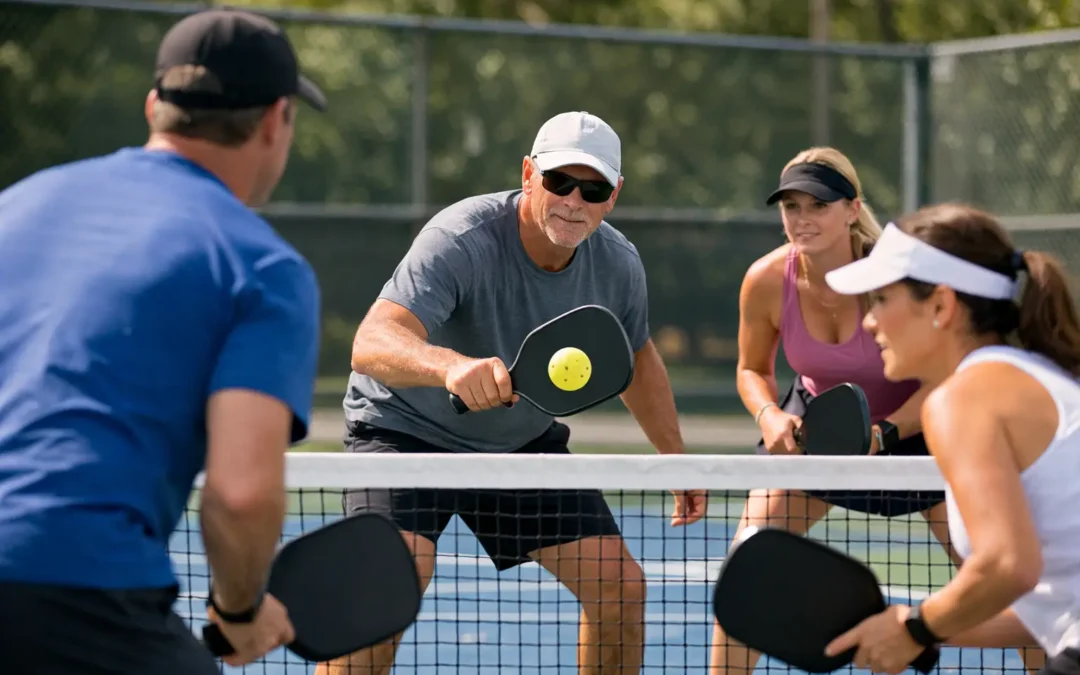
The point usually isn’t lost on the put-away. It’s lost two shots earlier, when one partner hangs back, both players chase the same ball, or a rushed return keeps the team pinned at the baseline. That’s why any real pickleball doubles strategy guide has to focus less on highlight shots and more on patterns, spacing, and decisions you can repeat under pressure.
At Around The Post Pickleball, we see this every day with players across clinics, boot camps, and competitive sessions in the Hamptons and Eastern Long Island. The teams that improve fastest are not always the ones with the biggest serves or hardest drives. They’re the teams that move together, communicate early, and understand when to speed the ball up and when to stay patient.
What actually wins in doubles
Doubles is a positioning game first. If your team controls the non-volley zone line more often, takes away the middle, and forces opponents into awkward contact points, you’ll win a lot of points before anyone hits a winner.
That sounds simple, but it changes how you should think about every shot. A serve is not just a way to start the rally. A deep serve buys time and can keep the returner from stepping in comfortably. A return is not just a ball in play. A solid, deep return gives the returning team time to reach the kitchen line together. A dink is not passive. It’s a tool to move opponents off balance and create a ball you can attack.
Most recreational teams get in trouble because they treat every ball as a separate event. Stronger doubles teams understand sequence. They know what they want the next shot to look like.
Pickleball doubles strategy guide for positioning
If you only fix one thing, fix your spacing with your partner. Doubles works best when both players defend and attack as a unit. When one player is at the kitchen and the other is stranded three steps behind, the team creates a gap that better opponents will target immediately.
After the serve, the serving team should expect to hit at least one ball from deeper in the court because of the two-bounce rule. That means the goal is not to sprint blindly to the kitchen. The goal is to hit a controlled third shot, then move in together behind a ball that earns the advance. Sometimes that’s a third-shot drop. Sometimes it’s a third-shot drive that produces a weak block. It depends on your skill set, the depth of the return, and how solid your opponents are at the line.
On returns, the priority is cleaner. Hit deep, then move forward with intention. If one partner charges and the other hesitates, the team leaves a hole in transition. Good doubles players are constantly checking whether they are connected side to side and front to back.
The other major positioning principle is middle responsibility. In many teams, the middle becomes a source of confusion. Two players back off. Or both take the same ball. As a general rule, forehands in the middle are stronger than backhands, but that is only a starting point. If one player has a dominant forehand poach or better hands, the team should build around that. The right answer is the one both partners understand before the point starts.
Move with the ball, not after it
One of the biggest tells of an inexperienced doubles team is late movement. The ball goes crosscourt and both players stay frozen, then react when the attack comes. Better teams slide together as the ball travels. If the ball is pulled wide to your right, both partners shift right. If your opponent is stretched and reaching, both players can lean in and expect a softer reply.
This does not mean overcommitting. It means reading the quality of the contact. A balanced opponent with the paddle out in front can redirect anywhere. A defender on the run with a low backhand usually gives you fewer threats. Strong doubles positioning comes from reading those moments early.
How to build points instead of forcing winners
A lot of doubles points are lost by players trying to end rallies too soon. The better play is often to apply pressure in layers. Push your opponents deep. Get to the line. Establish a dink rally. Move one player off the court. Then attack the next ball that sits up.
That patience matters even more against teams with quick hands. If you speed up from below the net at a set defender, you’re often starting a firefight on their terms. A smarter attack comes off a ball above net height or one that catches an opponent leaning, reaching, or moving backward.
The same idea applies to drives. A drive can be a great doubles shot, especially if you hit it with shape and target the right body line. But if every third ball is a full-speed drive at a ready opponent, the pattern gets predictable. Mixing in drops, heavy topspin rolls, and occasional pace changes makes your team much harder to read.
Target the right player and the right space
Not all opponents should be played the same way. Against a player with shaky backhand dinks, keep that side working. Against an aggressive poacher, hold your line and make them prove they can cover what they leave behind. Against a team that loves speed-ups, lower the bounce and avoid giving them attackable balls in the middle of the court.
There is also a difference between hitting away from a player and hitting through a team. Many doubles players aim too close to the sideline and donate errors. High-level pressure often comes from safer targets: at the inside foot, at the right shoulder, or through the middle when opponents are undecided. Middle balls create hesitation, and hesitation wins plenty of points.
The communication piece most teams ignore
The best partnerships sound organized, not noisy. Clear, early communication matters far more than constant chatter. A simple “switch,” “mine,” “bounce,” or “watch” can clean up a lot of confusion.
Before a point, talk about the return, the likely third ball, and who wants middle balls in fast exchanges. During the point, communicate only what helps the next decision. After the point, make small adjustments instead of giving a lecture.
This is especially important in mixed-skill pairings. If one partner is stronger, the answer is not to take over every rally. That usually creates tension and bad spacing. The better approach is to define patterns that help both players succeed. Maybe one player takes more middle forehands at the line. Maybe the other focuses on deep returns and disciplined crosscourt dinking. Good doubles strategy is rarely about ego. It’s about clarity.
Pickleball doubles strategy guide for common situations
When your team is stuck in transition, resist the urge to hit bigger just because you feel pressure. The highest-percentage choice is usually a controlled ball that buys one more step forward. Transition is where points get messy, so keep the paddle up, stay balanced, and expect the next ball at your feet.
When both teams are dinking crosscourt, pay attention to height and rhythm. If your opponents are comfortably settled, you need a purpose beyond simply keeping the ball in play. Change the spin, move the contact point wider, or bring a ball back through the middle to test communication. The goal is not random variety. The goal is a slightly weaker reply.
When facing a hard-driving team, your defense starts with your ready position. Keep the paddle out front, soften your grip, and block into safer areas rather than trying to counter every ball. Counterattacks work best when you’re balanced and the ball is not jamming your body. Sometimes the right shot is a reset, not a hero swing.
And when you have a lead, stay with the pattern that created it. Many teams play clean, patient doubles to get ahead and then rush points trying to finish quickly. Scoreboard awareness matters, but forcing offense because you want the game to end usually brings your opponents right back in.
What better teams do differently
They recover faster between shots. They understand that a good miss is different from a bad miss. Missing on an aggressive ball above the net is one thing. Missing a return long or popping up a routine dink is another. They also accept that style should match skill level.
For some teams, a third-shot drop-heavy game is the right identity. For others, especially athletic 3.5 to 4.0 players with solid counters, a drive-and-crash pattern may create more pressure. The point is not to copy what the best players on video are doing. The point is to build a doubles game your team can repeat consistently.
That’s where coached reps make the biggest difference. Strategy sounds easy in conversation. It gets real when you have to hit the right ball with your partner moving, your feet working, and the score adding pressure. Repetition turns good ideas into habits.
If you want your doubles game to improve, start with the pieces that show up every match: serve deeper, return deeper, move together, own the middle with a plan, and attack only when the ball earns it. Fancy shots are fun. Connected doubles wins more often. The teams that keep improving are the ones willing to play smart first and flashy second.