
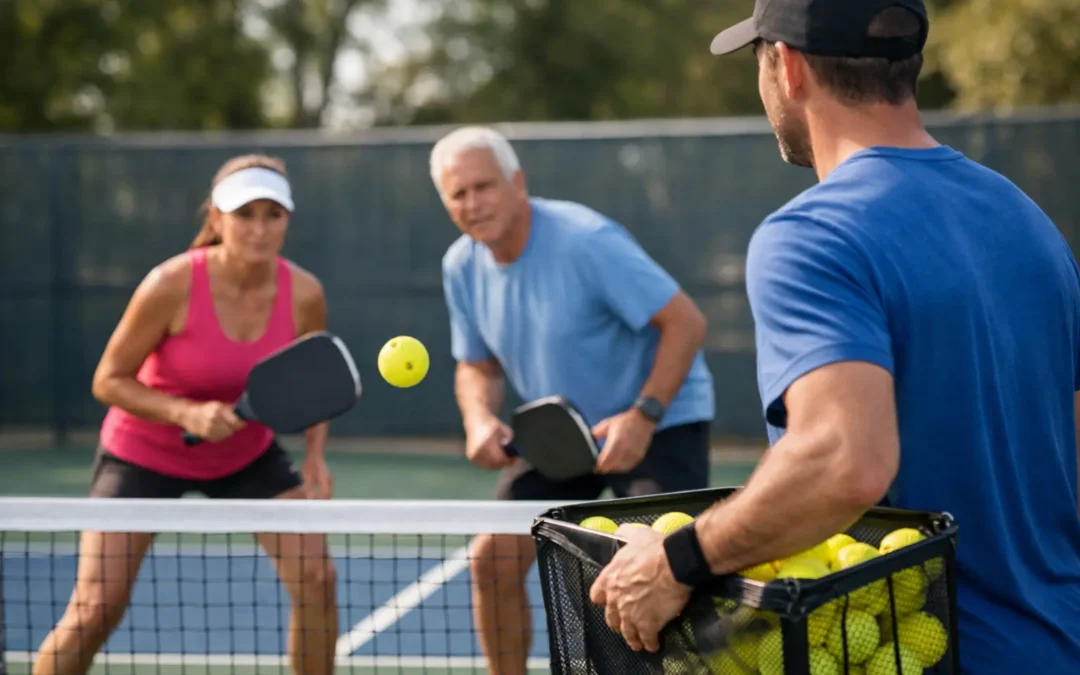
You can feel the difference in the first 10 minutes. In a full clinic, you may get good energy and solid instruction, but your reps can disappear fast. In a one-on-one lesson, every ball comes to you, but the pace and cost are different. That is exactly why so many players ask about semi private pickleball training benefits – it sits in the sweet spot between personal attention and live, realistic play.
For adults who want structure, measurable improvement, and a more social experience than a private lesson, semi-private training often makes the most sense. It gives you enough coaching to actually fix things, enough live interaction to make the lesson transferable to games, and enough shared momentum to keep the session fun. If your goal is to improve with purpose instead of just getting more court time, this format deserves a serious look.
Why semi private pickleball training benefits stand out
Semi-private training usually means two to four players working with one instructor. That small-group format changes everything. The coach can still see your habits, correct your mechanics, and tailor drills to your level, but the session also includes the decision-making, communication, and pressure that make pickleball feel real.
That matters because pickleball is not just a technique sport. It is a timing sport, a pattern sport, and a partnership sport. You do not just need a better third shot drop or a cleaner volley. You need to know when to use those shots, how to recover after them, and how to execute when another player is speeding the ball up at your body. Semi-private sessions create enough game context for that learning to stick.
For many players, the biggest gain is efficiency. You are not waiting through a large rotation, and you are not paying for every minute of solo instruction. You are getting a focused amount of feedback and a high number of useful reps in the same hour. That combination is hard to beat.
More personal coaching without the full private lesson price
One of the clearest semi private pickleball training benefits is the balance between value and attention. In a larger clinic, the instructor has to coach the room. In a semi-private, the instructor can coach you.
That does not mean every second is about your individual swing. It means your footwork, paddle position, contact point, and shot choices are actually visible to the coach. Small issues that get missed in bigger groups are much easier to catch. Maybe your ready position drops after every dink. Maybe your serve return leaves you flat-footed. Maybe your transition zone habits are creating the same mistake over and over. Those details are where players start to make real jumps.
At the same time, splitting the session with another player or a small group keeps the cost more approachable than a private lesson. For players who want consistent training instead of a one-time experience, that matters. Improvement usually comes from repetition over time, not a single great lesson.
Better reps and more game-relevant learning
Not all reps are equal. Hitting 100 balls is useful only if those balls connect to the situations you actually face in matches. Semi-private lessons tend to produce higher-quality reps because the coach can build drills around realistic exchanges.
You are more likely to work on serve plus one patterns, third shot decisions, reset balls in transition, hand battles at the kitchen, and partner communication. Those are the moments that decide points for most recreational and intermediate players. They also happen fast, which is why small-group instruction works so well. You can get immediate feedback, repeat the pattern, and then test it again with another live player across the net.
That live element is a major advantage over training completely alone. A private lesson can sharpen mechanics very quickly, and sometimes that is exactly the right choice. But if you struggle to carry those improved mechanics into actual games, semi-private training can close the gap. It blends technical work with situational play in a way that feels more transferable.
Confidence grows faster when you train with others
A lot of adult players do not need more information. They need more trust in what they already know. Confidence often improves faster when you are training beside another player instead of performing alone in front of a coach.
There is less pressure than a full private lesson for some people, especially newer players. You can see another player work through the same concept, hear corrections that help both of you, and settle into a rhythm. That shared environment lowers the intimidation factor while still keeping standards high.
For intermediate and advanced recreational players, confidence grows for a different reason. The pace is competitive enough to expose weaknesses, but controlled enough to fix them. You are not just surviving points. You are learning how to build them. That shift is what helps players walk into open play, league matches, or tournament settings with more clarity and less guesswork.
The social side is not a bonus – it is part of the value
Pickleball is social by nature, and training works better when people actually enjoy showing up. Semi-private lessons create accountability without making the experience feel rigid. When you train with a spouse, a friend, or a regular small group, you are much more likely to stay consistent.
That consistency is where progress happens. Players improve when they build momentum week after week, not when they drop into random sessions with no continuity. A semi-private format makes that easier because it feels both structured and enjoyable.
This is especially true in communities where players want quality instruction and a strong social outlet at the same time. In places like the Hamptons and Eastern Long Island, many players are looking for more than just a drill bucket. They want a professionally run experience that helps them improve and keeps them connected to the local pickleball scene.
Semi-private works for more levels than people expect
Some players assume semi-private training is only for beginners who want a gentle entry point. Others think it is only for advanced duos drilling at high speed. The truth is that it works well across a wide range of skill levels – if the group is set up properly.
Beginners benefit because the format is welcoming and less overwhelming than a packed clinic. They can learn scoring, positioning, and core mechanics in a setting where questions are easy to ask and repetition is easy to get.
Intermediate players often get the biggest return. This is the stage where players need targeted corrections, but they also need pattern work, point construction, and better decision-making. Semi-private training supports all of that.
More advanced recreational players can use the format for specialty work. Maybe the focus is on aggressive net play, transition resets, stacking, or doubles communication. In a small group with the right instructor, those sessions can be sharp, demanding, and very specific.
The only real catch is group fit. If one player is brand new and another is close to tournament-ready, the lesson may be less efficient for both. The best programs pay attention to level matching so everyone gets challenged appropriately.
What to look for in a semi-private program
The format matters, but the coaching matters more. A good semi-private lesson is not just a private lesson with extra people dropped onto the court. It should be intentionally designed.
Look for certified instructors who can teach mechanics and manage group flow at the same time. That means knowing when to stop and correct, when to keep players moving, and when to shift from isolated drilling into live play. The best coaches can make a small-group session feel personal without losing tempo.
It also helps to choose a program with real teaching volume and a strong local reputation. Around The Post Pickleball has taught more than 3,500 players across the region, and that kind of experience shows up in the details – smart groupings, clear progressions, and coaching that meets players where they are instead of forcing everyone through the same lesson.
Is semi-private training the right choice for you?
It depends on what you need most right now. If you have a very specific technical issue and want maximum repetition on one skill, a private lesson may be the better short-term choice. If you love energy, variety, and a lower price point, a larger clinic may fit.
But if you want a strong middle ground – personalized coaching, meaningful reps, game-like situations, and a format you will actually want to return to – semi-private training is one of the smartest investments you can make in your game.
The best part is that progress in pickleball does not have to feel isolated or overly serious to be real. A well-run semi-private session can be focused, social, challenging, and fun all at once. That is usually when players improve the fastest – when the instruction is clear, the reps have purpose, and showing up each week feels like something to look forward to.