
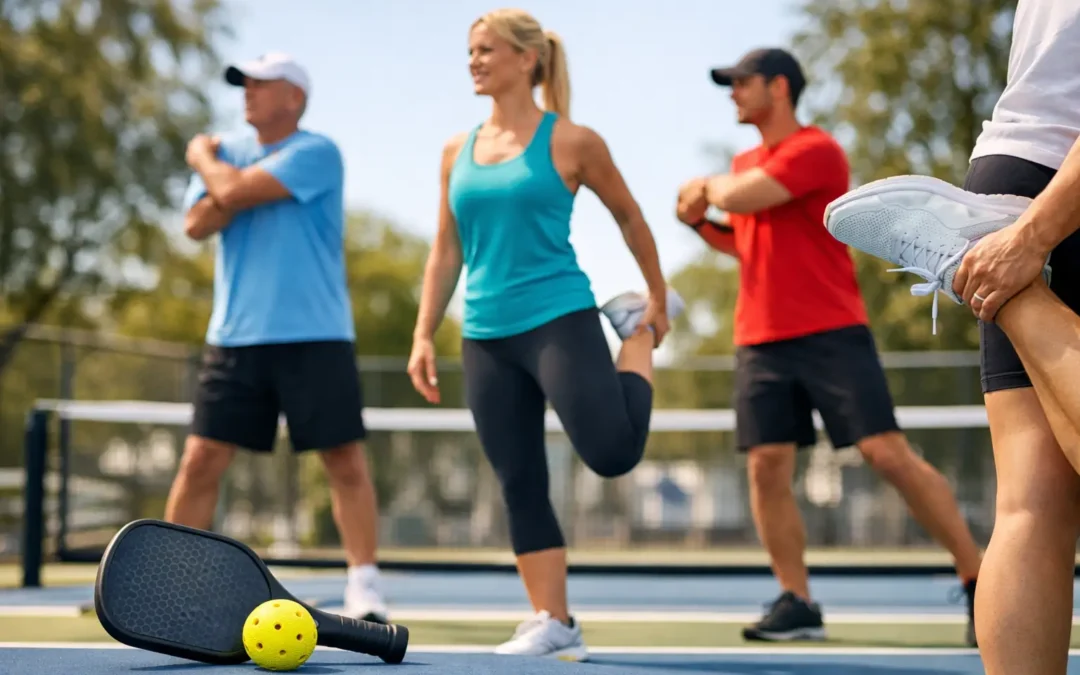
The first five minutes on court usually tell the story. If your feet feel heavy, your dinks sit up, and your first few serves land short, the problem is often not your technique – it is that you started cold. The best pickleball warm up routines get your body ready to move, your hands ready to react, and your timing ready before the first point matters.
At Around The Post Pickleball, we see this across every level, from first-time players to experienced 4.0 competitors. The players who warm up with purpose tend to settle in faster, move more efficiently, and avoid that sloppy first-game stretch where everything feels a beat late. A good warm-up does not need to be long or complicated, but it does need to match how pickleball is actually played.
What the best pickleball warm up routines should do
A real pickleball warm-up is not just about breaking a light sweat. It should raise your core temperature, open up the joints that take the most stress, and prepare you for the movement patterns you are about to use. That means short accelerations, quick stops, lateral movement, rotation through the torso, and hand speed at the kitchen.
This is where many recreational players lose the plot. They do a couple of static stretches, take three casual dinks, and call it good. Static stretching has its place, especially after play or when addressing a specific mobility issue, but right before a match, dynamic movement usually gives you much more. You want your body awake, not sleepy.
The other piece is mental readiness. Warm-ups are not only physical prep. They help you find rhythm, judge the bounce, feel your paddle face, and settle your nerves. That matters even more in tournament settings, league play, or any competitive environment where the first few rallies are not a dress rehearsal.
Best pickleball warm up routines for most players
If you want one practical framework, think in three phases: activate, move, then hit. That sequence works well because it builds from general preparation to sport-specific readiness without wasting energy.
1. Start with full-body activation
Begin off the court with two to three minutes of controlled movement. March in place, jog lightly, or do small side shuffles. Add arm circles, shoulder rolls, and trunk rotations. Then move into leg swings front to back and side to side, bodyweight squats, and walking lunges with a gentle torso turn.
This phase should feel easy to moderate, not exhausting. The goal is to get blood flowing and wake up the hips, shoulders, calves, and core. Those areas do a lot of work in pickleball, especially when you are transitioning from the baseline to the non-volley zone or reacting to a fast exchange.
2. Add footwork that looks like pickleball
Once your body is warm, shift into movement patterns you will actually use. Do short lateral shuffles, split-step resets, and a few quick forward and backward transitions. Keep the distances small. Pickleball is not about long sprints. It is about compact, efficient movement and being balanced when you hit.
A simple sequence works well here: shuffle three steps right and back, three steps left and back, then practice split step into a short forward move as if you are closing to the kitchen. Repeat for 30 to 45 seconds at a time. If you are older or coming back from tightness, keep the intensity lower and focus on clean movement quality.
3. Wake up the hands with soft dinks
Now get the paddle involved. Start at the kitchen with cooperative dinking. Keep the pace controlled at first. Focus on contact point, paddle angle, and touch. This is one of the most effective ways to bridge the gap between physical warm-up and actual play because it starts demanding precision without forcing max effort.
If you skip straight to hard drives, your touch often lags behind. Soft dinks let you build feel first. After a minute or two, you can widen the dink pattern and challenge each other to move laterally while staying compact and balanced.
4. Progress to volleys and hand speed
After dinks, move into cooperative volleys. Start with medium pace from the kitchen line, then gradually increase speed. Keep your posture athletic and your paddle out in front. This part of the warm-up matters because many points in pickleball are won or lost on reaction time and paddle readiness, not raw power.
Do not turn this into a firefight too soon. If you go from zero to full-speed hands battles, you can lose control and tighten up. Build speed gradually so your eyes, feet, and hands sync together.
5. Rehearse transition shots
One of the smartest additions to the best pickleball warm up routines is transition work. Start one player at the baseline and one at the kitchen, then practice a third-shot drop or controlled drive followed by the move forward. Rotate roles after several balls.
This is where warm-up starts becoming match prep. You are not just moving anymore. You are rehearsing one of the most important patterns in the game. For intermediate and advanced players, this is often the point where confidence really clicks in.
6. Hit serves and returns with intent
Before play starts, take a few serves and returns that actually resemble what you want in a game. Aim deep. Work on height over the net. Focus on routine and target, not just getting the ball in.
This is especially useful for players who need a few reps to find length and rhythm. A rushed pre-match serve often produces that familiar first-game problem: short balls that invite immediate pressure. A handful of focused reps can clean that up fast.
7. Finish with two or three live points
If time allows, play a few controlled points. Not a full game. Just enough to connect the warm-up to real decision-making. These points expose anything that still feels off, whether it is your movement, your touch, or your shot selection under slight pressure.
For tournament players, this final step can be a big separator. It helps remove that feeling that the match itself is your first real rep of the day.
How long should a pickleball warm-up be?
For most players, eight to twelve minutes is enough. If you are playing early in the morning, coming off a long car ride, or dealing with stiffness, you may need closer to fifteen. If you are in hot weather and already loose, you can get ready a little faster.
The trade-off is energy. A warm-up should sharpen you, not drain you. Older adults, newer players, and anyone managing previous injuries usually do better with a steady build rather than a fast, intense start. More advanced players can often tolerate a slightly higher pace, but even then, the goal is readiness, not fatigue.
Common mistakes that make warm-ups less effective
The biggest mistake is being too passive. Standing around and chatting while waiting for a court might be social, but it does not prepare your body for explosive stops, starts, and reaches. The second mistake is doing only static stretches and mistaking that for full preparation.
Another common issue is warming up only your favorite shots. Players will groove speed-ups or overheads but ignore dinks, drops, and returns. That may feel fun, but it is not always what translates to better opening points. Good warm-ups should reflect the full demands of the game, especially the shots that establish control.
Finally, many players warm up inconsistently. They do one routine on league night, another before a clinic, and nothing at open play. That makes it harder to build a reliable pre-match rhythm. Consistency matters because your body and mind start to recognize the routine as a cue that it is time to compete.
Adjusting the routine for your level
Beginners should keep things simple. Focus on general movement, a few kitchen dinks, some easy volleys, and several serves and returns. There is no need to overcomplicate it. The main goal is to feel coordinated and confident.
Intermediate players usually benefit from adding transition work and more targeted footwork. This is the level where better warm-ups can noticeably improve match starts because players are beginning to rely more on patterns, not just basic ball control.
Advanced recreational and tournament players should make the warm-up more specific, not necessarily longer. That means quality reps for drops, resets, directional dinks, and competitive hand-speed exchanges. The details matter more when the margins are smaller.
A routine that fits the social side of the sport too
Pickleball is competitive, but it is also deeply social. A strong warm-up does not have to strip that away. In fact, partner-based routines often improve communication before the match even starts. You learn each other’s pace, timing, and tendencies right away.
That matters whether you are heading into a serious event, joining a clinic, or showing up for a high-energy social session in the Hamptons. The best pre-game routine is the one you will actually use consistently, and that usually means it feels practical, repeatable, and connected to how you play.
If you want better starts, cleaner movement, and fewer wasted points early in games, treat your warm-up like part of your performance, not an optional extra. A few focused minutes before you play can change the quality of the entire session.