
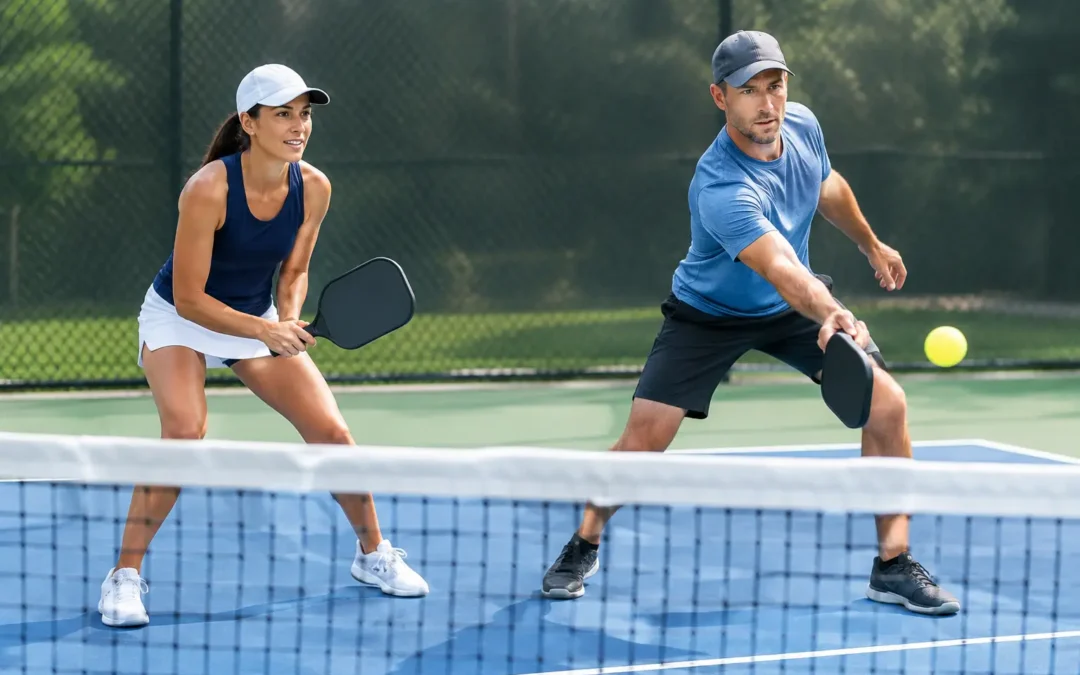
A close doubles match rarely turns on one spectacular winner. More often, it turns when one team gives away three points through a rushed third-shot drive, a ball left in the middle, and two players standing at different depths. The top pickleball doubles tactics are built to prevent those small breakdowns while creating pressure your opponents feel on nearly every ball.
At Around The Post Pickleball, our certified instructors have taught more than 3,500 players across The Hamptons and Eastern Long Island. The pattern is clear: recreational teams improve fastest when they stop treating doubles as two separate singles players sharing a court. The best teams move, communicate, and make decisions as one unit.
Top Pickleball Doubles Tactics Start With Positioning
Positioning is the foundation of effective doubles. If your team is out of position, even a technically sound shot can put you under pressure on the next ball.
The preferred offensive position is with both partners at or near the non-volley zone line, commonly called the kitchen line. From there, you can volley more balls, take time away from opponents, and apply pressure with compact swings. One player at the kitchen while the other remains near the baseline leaves a large gap and gives opponents an easy target at the advancing player’s feet.
That does not mean you should sprint forward after every return or third shot. Advance behind a ball that gives you time. A deep return, a well-placed drop, or a drive that forces a weak reply can create that opportunity. If your shot sits up, stay balanced, prepare for the next ball, and move forward only when the rally allows it.
Teams should also move laterally together. When your partner shifts toward the sideline to defend a wide dink, slide in the same direction to close the middle. Think of an invisible rope connecting you. If one player moves and the other does not, a hole opens immediately.
Respect the transition zone
The area between the baseline and kitchen line is where many rallies are lost. Players often get caught there with their feet still moving and their paddles low. Opponents recognize this and aim at the feet.
When transitioning, use split steps as your opponent contacts the ball. Keep your paddle up in front of your chest and prioritize a controlled block or reset over a flashy counterattack. The goal is not to win from the transition zone. The goal is to survive it, earn a neutral ball, and join your partner at the kitchen.
Win the Soft Game Before You Speed Up
At intermediate and advanced recreational levels, doubles points are often decided in the dink exchange. A patient team can pull opponents out of position, expose a weaker side, and wait for a truly attackable ball. A rushed team hands over errors.
Your default dink should be low over the net, land in the kitchen, and be difficult to attack. Crosscourt dinks give you more court length and a lower net in the middle, making them a high-percentage choice. Straight-ahead dinks can be effective too, especially when they pin an opponent near the sideline or prevent them from taking the ball aggressively out of the air.
The key is purpose. Do not dink simply because you have been told to play soft. Use the dink to move an opponent, test their patience, and create a ball above net height. If your opponent reaches wide, leans back, or lets the ball bounce too high, that is your opportunity to speed up with control.
Speeding up is not the same as swinging harder. Aim your attack at the right shoulder, hip, or paddle-side body of the opponent in front of you. Those targets reduce their reaction time and make a clean counter more difficult. Attacking directly down the middle also creates uncertainty about who should take the ball.
There is a trade-off. An attack that is too low or too close to a ready opponent often comes back faster than it left. When the ball is below the net, reset or continue the dink battle. Smart restraint wins more points than forced aggression.
Make the Middle Your Team’s Property
The middle of the court is valuable because it is both hard to defend and mentally disruptive. Balls down the middle can cause hesitation, crossed paddles, and late contact. But teams need a clear rule before they can use this tactic well.
For most right-handed pairings, the player with the forehand in the middle should take many balls that land between partners. That is usually the player on the left side of the court. For left-right partnerships, both forehands may cover the middle, which can be a major advantage if the pair communicates well.
This is a guideline, not an excuse to overreach. A ball that is clearly on your partner’s side should remain theirs. Call “mine,” “yours,” or “switch” early and loudly enough to remove doubt. Short communication is best during a fast exchange. Long explanations can wait until after the point.
The middle is also a strong serving target. A serve or return near the center line limits angles and can create confusion about which player should take it. Avoid getting predictable, though. If every ball goes middle, a disciplined opponent will adjust. Mix in depth, body shots, and occasional placement toward a weaker backhand.
Return Deep, Then Get to the Line
The return of serve is one of the few shots where you have time and control. Use it. A deep return keeps the serving team farther from the kitchen and makes their third shot more difficult.
After the return, move toward the kitchen line with intention. Do not drift forward while admiring your shot. Your partner should already be set at the line, and your job is to join them before the next ball arrives. If your return is short, you may need to pause in transition and prepare for a drive or drop.
A return does not need to be hard. Depth matters more than pace. A controlled return that lands near the baseline is usually more useful than a fast ball that sits in the middle of the court. Against players with a reliable third-shot drop, vary your return location rather than giving them the same look every time.
Use Third Shots That Match the Ball You Receive
The third shot is not a single tactic. It is a decision based on the quality of the return, your opponents’ position, and your own strengths.
When the return is deep and your opponents are established at the kitchen, a third-shot drop is often the right choice. The drop should arc over the net and land softly in the kitchen, allowing you and your partner to advance. It does not have to be perfect. A workable drop buys time and moves the rally toward neutral.
When the return is shorter, or an opponent is late getting to the line, a controlled third-shot drive can be effective. Drive through the middle, at the body, or toward the player with a less confident backhand. Follow the drive forward, but do not assume it will win the point. Be ready for a block, then reset the next ball if needed.
The strongest teams combine both options. If you drive every third ball, opponents will sit on the attack. If you drop every ball, athletic opponents may crowd the kitchen and take it out of the air. Variety makes your opponents hesitate, and hesitation is an advantage.
Communicate Before the Point, Not Just During It
Good doubles communication begins before the serve. Decide who covers lobs, who takes middle balls, and whether you will switch sides after a wide dink or attack. These small agreements eliminate confusion when the point speeds up.
Between points, keep feedback simple and useful. “More depth on the return” is helpful. “Stop missing” is not. Strong partners solve the next-ball problem rather than replaying the last error.
Body language matters as much as words. If your partner misses a straightforward put-away, offer a quick paddle tap and reset. Doubles teams feed off each other. Frustration spreads quickly, while calm energy can stabilize a match when momentum shifts.
Know When to Stack and When to Keep It Simple
Stacking can keep a preferred forehand in the middle, protect a weaker side, or create favorable matchups. It is especially useful for a left-right team or for advanced players with a clear strategy behind it.
But stacking adds movement, communication demands, and opportunities for confusion. It is not automatically better. If your team is still learning to move together, establish solid conventional positioning first. At the 3.0 to 4.0 level, clean footwork, reliable drops, and clear calls usually produce more results than a complicated formation.
Use stacking when it solves a real issue, not because it looks advanced. Practice the starting positions, the post-serve movement, and the response to a return down the middle before bringing it into a competitive game.
Build Tactics Through Intentional Reps
Tactics become dependable when they are trained under pressure. During open play, choose one focus for a few games: keeping both players at the kitchen, hitting deeper returns, or calling every middle ball. You will improve faster than if you try to fix everything at once.
In a clinic or drill session, rehearse the patterns that break down in matches. Work on third-shot drops followed by transition resets. Practice crosscourt dinks that turn into controlled speed-ups. Train middle-ball communication until both partners respond without hesitation.
The best doubles teams are not necessarily the teams with the hardest drives or quickest hands. They are the teams that stay connected, make high-percentage choices, and give opponents fewer easy balls. Bring one of these tactics into your next game, commit to it for a full session, and let the better decisions start changing the score.