
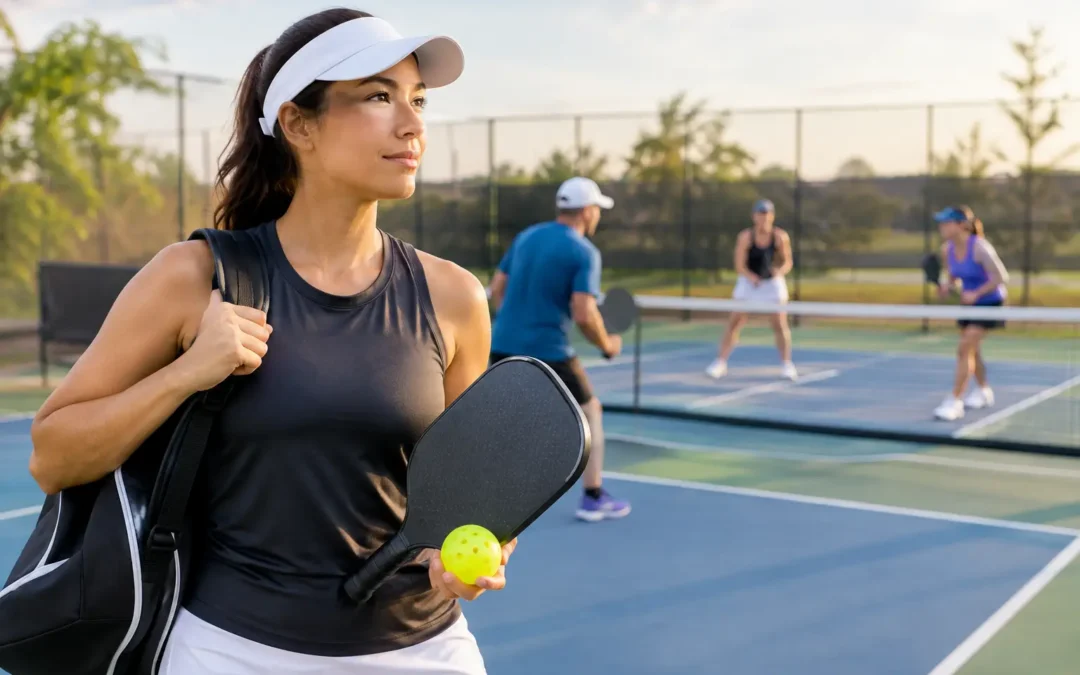
League play changes the feeling of a pickleball match. The score matters, your partner is counting on you, and every opponent brings a different style to solve. To prepare for pickleball league play, you need more than a few extra games at open play. You need purposeful reps, a dependable game plan, and the composure to compete when a close match turns on one point.
For players across The Hamptons and Eastern Long Island, league season is also one of the best ways to become part of the local pickleball community. Show up prepared, communicate well, and compete with the right energy, and you will get more out of every match – whatever your rating.
Prepare for Pickleball League Play With a Baseline
Start by getting honest about your current game. League matches expose patterns that casual play can hide. Maybe your third-shot drop is reliable in drills but disappears when opponents speed up. Maybe you can hit a strong serve, but you give away too many returns. Maybe your hands are quick, but you drift out of position when the rally gets chaotic.
Choose two strengths you can rely on and two priorities to improve before the season begins. Your strengths are the shots and decisions you can use under pressure. A consistent deep return, a patient reset, a well-placed serve, or calm dinking can anchor your game when conditions are not perfect.
Then identify the errors that cost the most points. For most recreational league players, those are not spectacular misses. They are unforced errors: returning serve short, trying to win a dink exchange too early, driving a ball that should have been dropped, or leaving the kitchen line without a reason. Reducing those mistakes often improves league results faster than adding a new highlight-reel shot.
Build Practice Around the Shots League Matches Demand
Playing more is helpful. Practicing with a purpose is better. Set aside time each week for focused repetitions before relying on games to do all the work.
Make the first four shots dependable
The serve, return, third shot, and fourth shot shape the point. At league level, they also reveal who is ready to control the kitchen line.
Serve with depth and intention. You do not need a flashy serve that occasionally produces an ace if it also creates avoidable faults or gives your opponent an easy ball. Aim deep, vary location, and know what you are trying to set up. A deep serve to the backhand may keep a player from attacking immediately. A serve to the middle can create uncertainty between partners.
Your return should be deep and give you time to move forward. Practice returning with enough margin over the net that you are not donating points. Then move in with purpose. Stopping in the transition zone makes you vulnerable to the next ball.
For the third shot, develop both a drop and a drive. The right choice depends on the return, your opponents’ court position, and your own consistency. If the return sits up and your team has a chance to create a weak block, a controlled drive can work. If your opponents are established at the kitchen line, a patient drop may be the higher-percentage play. League success comes from choosing the shot you can execute repeatedly, not forcing the shot that looks best.
Train your transition game
The area between the baseline and kitchen line decides a huge number of points. Players often rush forward after a third-shot drop, then get caught by a ball at their feet. Others hang back too long and give opponents the advantage at the net.
Practice moving through the transition zone with balanced, split-step footwork. Learn to reset a hard ball softly into the kitchen rather than swinging harder at a low contact point. A quality reset gives your team another chance to advance. That is a winning trade-off: a neutral ball now can become an attacking opportunity two shots later.
Practice dinking with a purpose
Dinking is not simply keeping the ball in play. It is a patient battle for a better ball. Work on crosscourt dinks, straight-ahead dinks, and the ability to change direction without creating an easy attack.
Your goal is to move opponents, test their patience, and wait for a ball you can attack above the net. If you are uncomfortable in extended dink rallies, do not avoid them in practice. Create them. The confidence to stay calm for 10, 15, or 20 shots is a major league advantage.
Create a Simple Match Plan With Your Partner
League teams do not need a complicated playbook. They do need clarity. Before the match, talk through how you will handle serves, returns, middle balls, lobs, and opponents who attack relentlessly.
The middle is especially important. Decide who takes balls down the center based on forehands, court position, and the shot coming in. There is no one rule that fits every partnership. Two right-handed players may favor the player on the left for many middle forehands, but a ball aimed at the right-side player’s forehand should not become a hesitation point. Clear communication matters more than rigid rules.
Use short, positive cues during play. Call “mine,” “yours,” “bounce it,” or “watch the lob” early and clearly. Between points, keep the conversation useful. Instead of saying, “Stop missing that,” try, “Let’s give them one more dink before we speed it up,” or, “Their backhand return is sitting up. Let’s serve there again.”
The best partners make each other steadier. That includes after an error. A quick paddle tap, eye contact, and a reset of the plan can keep one missed shot from becoming three.
Prepare Your Body for the League Schedule
League play can be more demanding than a single social game. You may play multiple matches, spend time waiting between rounds, and compete in heat, wind, or cooler shoulder-season conditions. Your preparation should match the schedule.
Arrive early enough to warm up your body and your touch. Start with light movement, shoulder and hip mobility, and a few minutes of easy dinking. Then hit serves, returns, drops, and volleys with increasing pace. Walking onto the court cold and trying to find your third-shot drop at 0-3 is a poor bargain.
Bring water, electrolytes when conditions call for them, and a snack that sits well for you. Do not experiment with new food, shoes, or paddle setups on match day. If you are changing equipment, give yourself time to adjust during practice first.
Recovery deserves attention too. A busy week of league matches and open play can catch up with your knees, calves, shoulders, and lower back. Build in rest, gentle mobility, and strength work that supports your movement. If pain changes your mechanics or gets sharper as you play, do not push through it just to finish a session. Staying available for the season matters more than winning one practice game.
Compete Better When the Score Gets Tight
Close games are rarely decided by one magical shot. They are usually decided by which team keeps making sound choices after the score reaches 8-8, 9-9, or game point.
Give yourself a repeatable reset routine. After every rally, turn away from the net briefly, take a breath, and choose one clear intention for the next point. It might be “deep return,” “get to the line,” or “be patient crosscourt.” This prevents the previous error from taking over the next rally.
When nerves rise, simplify. Hit bigger targets. Keep more margin over the net. Favor the shot you have practiced most. Aggression still has a place, but it should be intentional. A rushed speed-up from below the net is usually an invitation for a counterattack.
Also learn to read the other team. Who avoids the backhand dink? Who gets impatient? Who struggles with a ball at their feet? Who covers too much of the middle and leaves the sideline exposed? Make adjustments without becoming predictable. If a strategy works, use it until opponents prove they can solve it.
Get Match-Ready Before Week One
The best preparation includes pressure reps. Schedule practice games where you start at 7-7, play only to 11, or give one team a specific tactical goal. Play with different partners when possible. It will sharpen your communication and force you to adapt rather than relying on familiar patterns.
A clinic or drill-based session can also speed up improvement because it creates more repetitions than a standard game. Around The Post Pickleball has taught more than 3,500 players through certified instruction, clinics, tournaments, and competitive programming across the region. The right coaching environment helps players turn vague goals like “be more consistent” into specific habits they can trust in league play.
League season is not about playing perfectly. It is about becoming the player and partner who can settle into a match, make smart decisions, and keep competing when the point gets uncomfortable. Bring that mindset to the court, and every league night becomes a chance to build a stronger game and a stronger place in the community.